Search This Blog

Monday, April 8, 2013

Muscle Beach Party (1964)

A group of California teens are spending the summer at the beach surfing and partying. But a team of bodybuilders in the beach house next door as well as an Italian Contessa (Luciana Paluzzi) disrupt the summer fun. The second entry in the BEACH PARTY franchise suffers from a certain laziness. Even the songs (co-written by The Beach Boys' Brian Wilson) are on the blah side though Stevie Wonder (in his film debut) spices things up with the lively finger snapping Happy Street and cute as a button Donna Loren teaches us how to dance the Muscle Bustle. Teen icons Frankie Avalon and Annette Funicello (who died today which is why I watched this in her memory) are the stars and a more wholesome pair would be hard to find but one would have to struggle awfully hard not to like them. It's amusing though to watch the diminutive Avalon romance the statuesque Paluzzi who seems to overwhelm him. Directed by William Asher. With Peter Lorre, Buddy Hackett, Don Rickles, Morey Amsterdam, John Ashley, Jody McCrea, Michael Nader and that hip shaking beach bunny Candy Johnson.

Sunday, April 7, 2013

Night Moves (1975)

A former football player turned private detective (Gene Hackman) is hired by an ex-actress (Janet Ward) to find her missing 16 year old daughter (Melanie Griffith). While his wife (Susan Clark) is being unfaithful to him, the detective finds the elements of the case as bleak as his dismantling personal life. Directed by Arthur Penn (THE MIRACLE WORKER), this is a crucial example of neo-noir. The film's fatalistic narrative nicely captures the disheartenment of the prevalent mood of so many films of the 1970s while still remaining faithful to the formalities of classic film noir. I don't think anyone who's seen it has forgotten it. In one of his 3 or 4 best performances, Hackman shows why he was/is considered one of the best actors of his era. Bruce Surtees (THE OUTLAW JOSEY WALES) did the evocative cinematography and Michael Small (KLUTE) is responsible for the expressive underscore. With James Woods, Jennifer Warren, Edward Binns, Harris Yulin and Kenneth Mars.

The Gay Divorcee (1934)

An American heiress (Ginger Rogers) comes to England seeking a divorce from her British husband (William Austin). To this end, her lawyer (Edward Everett Horton) arranges for her to be caught in flagrante delicto with a professional gigolo (Erik Rhodes) by the husband. But she mistakes the American dancer (Fred Astaire) pursuing her as the co-respondent. After their spectacular success in FLYING DOWN TO RIO in supporting roles, this was Astaire & Rogers first star pairing and it pretty much set the template for all Astaire & Rogers musicals to follow. It's based on a Cole Porter musical called THE GAY DIVORCE (the production code insisted on a title change. A divorcee could be gay, a divorce could not) but with the exception of the glorious Night And Day, all Porter's songs were jettisoned. The script is witty and while Astaire and Rogers (and their dancing) are undeniably the stars, it's the supporting players who give the film its punch. Most notably Alice Brady (IN OLD CHICAGO) as Rogers' airhead Aunt and Rhodes as the Italian gigolo murdering the English language. Directed by Mark Sandrich. With Edward Everett Horton and a pre-stardom Betty Grable who are adorable doing Let's Knock Knees.

Saturday, April 6, 2013

The Company You Keep (2013)

A former radical member (Susan Sarandon) of a militant underground group from the early 70s that was responsible for a bank robbery and the murder of a guard, who under a different identity has been living the quiet life of a housewife for the last 30 years, is arrested by the FBI. Her arrest and the subsequent investigation by an ambitious young journalist (Shia LeBeouf) causes a domino effect with consequences for both the innocent and the "guilty". The director Robert Redford, who also plays the leading character (a lawyer outed as a former underground member who goes on the run), seems to want to play both sides of the fence. At times the film seems like an apology for the radicalism that hurt as much as it did good but it also stands defiant that they were in the right. It would have been better if it didn't sit on the fence and took a point of view one way or another. Yet to be fair, the film delves into the complexities of the era where everything seemed black and white at the time and only in retrospect, do we see the gray. If Redford's flawless character seems too good to be true, the other characters are given more shading and thus more interesting to us. The film seems on target for most of the way but near the end when there was a pivotal scene with Julie Christie (as another radical) sailing on a lake, I had an ominous feeling and thought, "Please end the film here! Please!". Alas, it didn't and the mawkish ending we're fed demeans everything good that came before it. The cast is stellar though: Nick Nolte, Chris Cooper, Terrence Howard, Brendan Gleeson, Stanley Tucci, Sam Elliott, Anna Kendrick, Jackie Evancho and Brit Marling. Based on the novel by Neil Gordon.

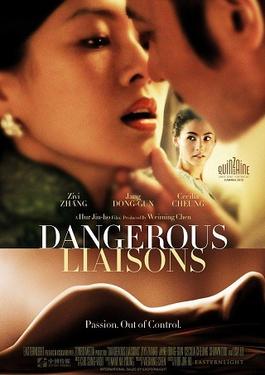
Wi Heom Han Gyan Gye (aka Dangerous Liaisons) (2012)

In 1931 Shanghai, a hedonistic playboy (Jang Dong Gun) and a wealthy businesswoman (Cecilia Cheung in the film's best performance) make a wager. If he can seduce the virtuous widow (Zhang Ziyi) of a beloved teacher, she will sleep with him. If he loses, he will give her a valuable piece of waterfront property. But when he falls in love with the widow, the socialite pushes the situation to a point where it will poison many lives. What is it about Pierre Choderlos De Laclos' 1782 novel that continues to fascinate both film makers and audiences? It's been filmed by Roger Vadim twice (in the 1950s then the 1970s), the well known 1988 Stephen Frears film followed the following year by Milos Forman's version, in 1999 there was the teen version called CRUEL INTENTIONS, in 2003 South Korea offered up its version and France did it again in the mini series format, several stage versions, two operas and a ballet! This version is from China (though its director Jin Ho Hur and its leading man are Korean). The pre-war 1931 Shanghai setting allows the sumptuous visuals (the eye candy wide screen cinematography is by Byung Seo Kim) but the ending is misguided and instead of sticking to the novel's tragic finale, it's more syrupy than irony. Still, that storyline is, as always, so compelling that it tends to push aside most complaints. The seductive score is by Sung Woo Jo. With Lisa Lu, Shawn Dou, Candy Wang and Rong Rong.

Friday, April 5, 2013

The Marriage Go Round (1960)

A happily married Academic couple, she (Susan Hayward) is the Dean Of Women and he (James Mason) is a professor, are entertaining a house guest from Sweden. But when the statuesque house guest (Julie Newmar, recreating her Tony award winning stage performance) makes a proposal that he father her baby, what begins as suggestion not taken seriously leads to a marital meltdown. What was daring and risque in the 1958 Broadway play by Leslie Stevens (THE WAR LORD) and its film version barely raises an eyebrow today. Which removes much of the play's teeth and leaves us with a gummy sex farce. Who thought it was a good idea to cast Hayward and Mason in a sex comedy anyway? Neither are exactly known for their farcical abilities. Fortunately, Newmar is a delight as the Swedish amazon who wants a genius to father her child and compensates for the two leads. However, Hayward does acquit herself nicely in a confrontational scene with Newmar over her husband. If only the rest of the film were on that level. Directed by Walter Lang (THE KING AND I). With Robert Paige and June Clayworth.

The Undercover Man (1949)

A U.S. Treasury agent (Glenn Ford) is frustrated in his attempts to bring down a mob syndicate to justice. Out of fear, no one wants to talk especially after one of Ford's mob contacts (Robert Osterloh) is murdered. Loosely based on the Al Capone case, this is a first rate job by director Joseph H. Lewis. As he proved with GUN CRAZY and THE BIG COMBO, he was adept at tight economical thrillers. This one is a no nonsense, gritty and fairly accurate portrayal of how Capone's empire was finally dismantled after the tax evasion case prepared by the Treasury. While Ford is more than adequate as the determined government agent, the film is bolstered with nice turns by an effective supporting cast down to the smallest parts. Robert Rossen (ALL THE KING'S MEN) produced, the sharp B&W cinematography is by Burnett Guffey (an Oscar winner for BONNIE AND CLYDE) and the solid score by George Duning (3:10 TO YUMA). Among the excellent supporting cast: Nina Foch, James Whitmore in his film debut, Barry Kelley (really good!), Kay Medford, Patricia Barry, Angela Clarke, Joe Mantell, Anthony Caruso, Howard St. John and as the man who turns the case around, Leo Penn (Sean's father).

The River (1929)

After her lover (Alfred Sabato) is arrested for murder, his mistress (Mary Duncan) chooses to remain behind in the deserted logging camp to wait for him during the long cold winter. But when a young boy (Charles Farrell) in his self made houseboat arrives, they find themselves strongly attracted to each other. It's difficult to appropriately judge this Frank Borzage film because so much of it has been lost including the film's beginning, ending and some large chunks in between. Those sections are filled in by film stills and intertitles providing a narrative based on the film's shooting script. But what remains is a lovely, even erotic (Duncan climbing into a nude Farrell's bed), romance between an older disillusioned woman and a young man who is still a virgin. Mary Duncan is a real find for me. A great screen presence with strong sex appeal. When, after a long separation, the two meet and he insists they celebrate and he takes out the checkers board, her look is priceless! What we have is good so I can only imagine how even better the film would be if so much of it hadn't been lost. With Ivan Linow as the deaf mute.

Thursday, April 4, 2013

The Silencers (1966)

A retired secret agent (Dean Martin), now working as a photographer, is recruited against his will back to work when enemy agents plot to drop a nuclear bomb in New Mexico for which the Russians will be blamed which will trigger another world war. Very loosely based on Donald Hamilton's novels THE SILENCERS and DEATH OF A CITIZEN, the screenplay credited to Oscar Saul abandons the serious tone of the Matt Helm books and instead turns it into a spy spoof and Matt Helm into a lecherous booze hound. Much of the film is vulgar with doses of sexism and racist humor (the Asian villain drinks diet Egg Foo Yung) but it's amiable and breezy so it's hard to take offense. Still, as a spy spoof it's more fun than the OUR MAN FLINT series. Martin, in particular, seems to be enjoying poking fun at his drunken satyr image and then there's luscious Stella Stevens to remind us what a sensational comedienne she was. The plot is pretty lame though even for a spoof. Directed by Phil Karlson. With Cyd Charisse (whose singing voice is dubbed by Vikki Carr) who gets to do one terrific number before they kill her off, Daliah Lavi, Robert Webber, James Gregory, Arthur O'Connell, Nancy Kovack and Richard Devon.

The Shining Hour (1938)

A nightclub dancer (Joan Crawford) marries into a wealthy landed gentry farm dynasty. But when she and her married brother in law (Robert Young) find themselves attracted to each other, things heat up so that her husband (Melvyn Douglas) and her sister in law (Margaret Sullavan) can't help but notice. Based on the play by Keith Winter (which was set in rural England), the play has been gussied up and given the full MGM treatment as befits Crawford. It's directed by Frank Borzage but it's a pretty soapy melodrama. Crawford is okay (except for her dancing which is ungraceful) but it's Sullavan who commands our attention and sympathy. There are no worse roles than those dreary quietly suffering noble wife roles but somehow Sullavan manages to invest the part with a dignity the picture doesn't deserve. By the end, things are getting pretty silly what with Fay Bainter as the resentful old maid sister going wacko (a la Mrs. Danvers in REBECCA) and setting the house on fire! With Hattie McDaniel, who's not given enough to do, Frank Albertson and Allyn Joslyn.

Tuesday, April 2, 2013

The Long Hot Summer (1958)

A Mississippi drifter (Paul Newman, who won the Cannes film festival best actor award for his work here) with a reputation as a "barn burner" arrives in a small town run by an imposing redneck (Orson Welles). The town's patriarch then schemes to marry off his spinster daughter (Joanne Woodward) to the hunky nomad. Meanwhile, his own son (Anthony Franciosa) finds himself in danger of being displaced by the drifter. Loosely based on William Faulkner's novel THE HAMLET and two short stories (BARN BURNING and SPOTTED HORSES), this is a wonderfully crafted piece of steamy entertainment. The screenwriters (Irving Ravetch, Harriet Frank Jr.) have soaked the dialog and atmosphere in faux Tennessee Williams fashion that one could be fooled into thinking it was the real thing and it's obvious that Welles' Will Varner is patterned after Williams' Big Daddy in CAT ON A HOT TIN ROOF. There's a genuine sensuality permeating almost every frame and the Alex North's superb music is one of the most erotic film scores ever written. Seamlessly directed by Martin Ritt. With Lee Remick, Angela Lansbury, Richard Anderson, Sarah Marshall and Mabel Albertson.

Monday, April 1, 2013

Sinatra (1992)

A young singer (Philip Casnoff) from Hoboken, New Jersey rises from band vocalist with the Harry James and Tommy Dorsey orchestras to one of the most iconic entertainers of the 20th century. The life of Frank Sinatra from an adolescent in 1920s New Jersey to his comeback from retirement in the 1970s at Madison Square Garden crammed into four hours is an almost impossible task to do properly and it isn't. It's more like great highlights (and low points) of his life. Sinatra is such a fascinating figure that despite its flaws, the film can't help but be entertaining. But there are problems. One, the film is produced by one of Sinatra's daughters (Tina Sinatra) and so is kinder to Sinatra than a more objective film maker would be. Two, Sinatra was a great Star with a potent presence whether in a nightclub or on a movie screen. Philip Casnoff  who plays him is more than decent in the part but, and it's a big but, he lacks everything that made Sinatra a Star. Casnoff's "Sinatra" would never have made it and it doesn't help that he's lip syncing to a Sinatra impersonator rather than ol' blue eyes himself. The same problem with Marcia Gay Harden as Ava Gardner. Harden is a better actress than Gardner ever was but she's not a Star. Gardner was a Star. So there's no heat between Casnoff and Harden when playing Sinatra and Gardner, none of the sparks they apparently gave off in their professional as well as real life. Directed by James Steven Sadwith, who won an Emmy for his direction. With Olympia Dukakis as Sinatra's mother, Gina Gershon as Nancy Sinatra (the wife, not the daughter), Nina Siemaszko as Mia Farrow, Bob Gunton as Tommy Dorsey, David Raynr as Sammy Davis Jr., Joe Grifasi, Jeff Corey and Rod Steiger as mobster Sam Giancana.