Search This Blog
Wednesday, January 15, 2014
Richard's Things (1980)
The Mad Room (1969)
Tuesday, January 14, 2014
Romance On The High Seas (1948)
When her husband (Don DeFore) bows out of their South American vacation because of business, his wife (Janis Paige) suspects he's having an affair. So she stays behind and sends a proxy (Doris Day) in her place on the cruise ship to pose as her and stays behind to spy on her husband. Meanwhile, the equally suspicious husband hires a private detective (Jack Carson) to go on the cruise and spy on his wife. Oh, what a tangled web they weave as mix-ups galore take place. Warners didn't have much luck with female musical stars in the 1940s. MGM had Judy Garland, Fox had Betty Grable, Universal had Deanna Durbin and Paramount had Betty Hutton. This was Doris Day's feature film debut and she became one of Warners' biggest stars right out of the gate. By the time Day gets around to singing the Oscar nominated It's Magic, you realize you've just seen a star being born. This is the closest Warners got to the look of an MGM musical in style and quality. Its script is clever, its leads attractive and the songs first rate. Day would have to wait another five years before she got another musical as good (CALAMITY JANE). That jack of all trades ("What couldn't he direct?") Michael Curtiz keeps the farce moving quickly along. With Oscar Levant, S.Z. Sakall, Eric Blore, Franklin Pangborn, Fortunio Bonanova and Avon Long.
Days Of Wine And Roses (1958)
A public relations executive (Cliff Robertson) and a secretary (Piper Laurie) meet at a rooftop office party. They are immediately attracted to each other but their avid social drinking will soon escalate into full tilt alcoholism which will take them through a Hellish journey and from which only one will survive. Most everyone has seen or is at least aware of the 1962 Blake Edwards film version but not many have seen the original 1958 production which is a pity. A pity because it's superior to the 1962 film (which isn't bad at all) in most ways. Fifty-five years later, it still packs a wallop! The sheer jumping out of their skin desperation of Robertson and Laurie as they panic for another drink in a grungy flat is palpable and heartbreaking even as you're repulsed. Robertson is wonderful here but it's Piper Laurie who's the revelation and one can't help but wonder what Universal was thinking when it wasted her in minor westerns and Arabian nights adventure flicks. The direction by John Frankenheimer is strong and one can see why the movies quickly snapped him up. With Charles Bickford who would go on to play the same role in the 1962 film, Malcolm Atterbury and Marc Lawrence.
Monday, January 13, 2014
The Great Gatsby (1949)
In the 1920s, a man (Alan Ladd) with recently acquired wealth and a mysterious past buys an enormous mansion on Long Island. His aim is to win back the love (Betty Field) of his youth, who is now married to a member (Barry Sullivan) of Long Island's social set and lives across the bay from his new mansion. The second film adaptation (the first was in 1924) of the classic F. Scott Fitzgerald book has some good things about it but it is hopelessly compromised by 1940s morality which changes important aspects of the Fitzgerald novel. No more so that the film's ending which erases Tom Buchanan's complicity in Gatsby's death and Daisy's insistence on turning herself in to the police. For some inexplicable reason, the screenwriters have made Jordan Baker (Ruth Hussey) rather self centered and not above blackmail to get what she thinks she deserves. Films of the 1940s and 1950s were notorious for being lackadaisical when it came to accuracy for films set in the 20s where everyone and everything looked 40s or 50s. That's not the case here, especially so in Edith Head's costumes. Surprisingly, Ladd does some of his best work here and his scene with Daisy when he shows her his new clothes may be the best piece of acting he's done and with a stronger director and better script, you can see that he might have been a perfect Gatsby. Gatsby's death is quite graphic for its day (blood and bullet holes). Directed by Elliott Nugent. With Macdonal Carey as Nick (weak), Shelley Winters as Myrtle (good), Howard Da Silva (who would also star in the 1974 film version), Ed Begley, Henry Hull, Elisha Cook Jr. and Carole Mathews.
Sunday, January 12, 2014
An Artist's Story (1974)
In late 19th century Russia, an artist (Patrick Stewart) living in the country becomes involved with two sisters. One (Meg Wynn Owen) does good deeds for the poor and has a slight contempt for the artist while her younger sister (Emma Williams) hopes to learn from him. Based on a short story by Anton Chekhov, this is a slight piece that pits the artist whose search for truth he considers more important than anything against the older sister who feels his search for truth is merely a justification for doing nothing in helping the poor and oppressed. Will the search for truth free the peasants and thus release them from hard labor and poverty or must we do what we can to alleviate their suffering even if only temporary. Chekhov seems to be slightly disposed to the artist's argument but the story's ambivalence never lets us know sure. Directed by David Jones. With Brenda Bruce and Philip Locke.
Psycho (1998)
Never Let Me Go (1953)
An American journalist (Clark Gable) marries a Russian ballerina (Gene Tierney) but when he leaves for the United States, the Soviets refuse to let his wife accompany him and refuse him entry back to the Soviet Union. He then conceives a daring plan to sneak back into Russia and help his wife escape. Directed by Delmer Daves (A SUMMER PLACE), this is a rather lackluster romance which isn't helped by the lack of chemistry between Gable and Tierney. The film does whip up some tension during its last twenty minutes during the escape with much of the dialogue in Russian with no English subtitles thus leaving us unsure of what is going on. Gable is, well, Gable but Tierney is quite touching and she does a credible Russian accent though it's obvious she has a dance double for the ballet sequences. Not surprisingly considering the time in which it was filmed, the Russians are portrayed unfavorably. Filmed in Great Britain, the movie takes advantage of the Cornwall coast during its English section. With Kenneth More, Richard Haydn, Bernard Miles, Theodore Bikel, Belita, Karel Stepanek, Anna Valentina and Anton Diffring.
Saturday, January 11, 2014
The Owl And The Pussycat (1970)
When a part time hooker (Barbra Streisand) gets kicked out of her apartment in the middle of the night because her neighbor (George Segal), a nerdy failed writer complained about her activities, she barges into his apartment and demands that he put her up for the night. Thus begins an unlikely romantic relationship. Based on the two character play by Bill Manhoff, the screenplay by Buck Henry opens up the film a bit but not by much. Despite the minor characters hovering around the fringe of the film, it's still essentially a two character piece. Quite daring for its day, it seems almost quaint today though inexplicably Streisand (who had her nude scene eliminated from the film) uttering the "F" word was cut from the film shortly after it was released and has never been reinstated. The film is dialogue heavy and the writing is uneven though fortunately Streisand and Segal have such a smooth chemistry that it's a pity they didn't work again in their prime (Segal had a small part in her THE MIRROR HAS TWO FACES). The easy listening pop/jazz score is by Richard Halligan of Blodd, Sweat & Tears and is performed by the band. Directed by Herbert Ross. With Robert Klein, Allen Garfield, Roz Kelly and porn actress Marilyn Chambers (BEHIND THE GREEN DOOR).
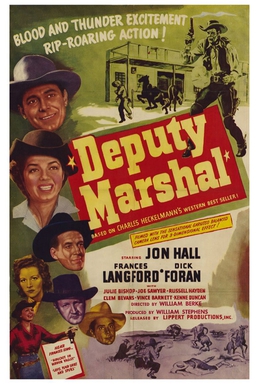
Deputy Marshal (1949)
A U.S. deputy marshal (Jon Hall, THE HURRICANE) is given a piece of paper by a man (Wheaton Chambers) before he is shot to death. The marshal keeps the content of the paper to himself as he investigates not only who killed the man and why. Undistinguished low budget fodder tossed off for the lower half of a western double bill. So generic that I was shocked to see it was based on a novel by Charles Heckelmann. It's the kind of time filler that often popped up on TV in the 50s and 60s for a Saturday matinee. For old movie buffs, it has some minor interest like seeing Hall and his then wife the singer Frances Langford (the movie stops cold when she sings two songs) in their only film together. The film's "B" status is further ensured by what appears to be an awful cobbled together (and uncredited) underscore of stock music, I certainly hope no one was actually paid for writing that junk. Directed by William Berke. With Dick Foran, Julie Bishop, Joe Sawyer, Mary Gordon and the rubber faced Clem Bevans, who gives the film its only life.
Friday, January 10, 2014
Naked Lunch (1991)
A bug exterminator (Peter Weller, ROBOCOP) gets high by shooting up with his own bug poison. When he accidentally kills his wife (Judy Davis), he flees to the "Interzone" which is in the Middle East and where the "black meat", the dried intestines of giant sea centipedes, are ground into powder and distributed as a hallucinatory. Based on William S. Burroughs controversial 1959 novel, this is a hard film to describe easily as its narrative is essentially one long surreal hallucination while on drugs. It's certainly a film to be avoided if one is in any way entomophobic! If the director David Cronenberg's THE FLY freaked you out, he goes even further here. Typewriters turn into roach like creatures and talk to you (through what looks like a rectum), insect like creatures are ripped apart exposing their innards and giant insects get sexually aroused and join humans for sex. Yes, definitely not for the squeamish. It's a fascinating abstract journey into the mind of a junkie with a precise eye for the 1950s "Beat" generation. The expressive jazz score is by Howard Shore. With Roy Scheider, Ian Holm, Julian Sands, Nicholas Campbell, Michele Mercure and Joseph Scoren.
Thursday, January 9, 2014
Sex Kittens Go To College (1960)
Subscribe to:
Posts (Atom)