Search This Blog

Tuesday, August 9, 2011

Elvira: Mistress Of The Dark (1988)

The trashy and tacky Elvira (Cassandra Peterson) hosts a TV show that runs bad sci-fi and horror films. She needs money to finance her Las Vegas act. When her great aunt from New England dies and leaves Elvira an inheritance in her will, she finds all she has inherited is a dilapidated old house, a poodle and a recipe book (which is really a book of spells). Worse, the uptight and puritanical townspeople treat her like a pariah. This horror comedy manages to be both cheesy and legitimately funny and near irresistible. The closest equivalent that I can think of would be ABBOTT & COSTELLO MEET FRANKENSTEIN. It's silly yet there's an eagerness to please that makes the silliness work. The comedic highlights include Elvira's FLASHDANCE parody, her "casserole" dinner and a picnic in which she casts a sex spell on the town's puritans. Peterson squeezes all the double entendres she can out of her ditzy, cheap dingbat and everyone is pretty much a straight man to her though Edie McClurg as Chastity Pariah, the town's moral arbiter, manages to steal a few scenes. Directed by James Signorelli. With Daniel Greene and Susan Kellerman.

Rope Of Sand (1949)

Set in South Africa, a former hunting guide (Burt Lancaster), who was falsely accused of stealing diamonds from a diamond mining corporation and tortured by a corrupt police captain (Paul Henreid), returns to get revenge ..... and the diamonds. Directed by William Dieterle (HNCHBACK OF NOTRE DAME), this neat and nasty cat and mouse thriller is quite enjoyable. Lancaster's hero has more brawn than brains, it was his own stupidity that got him in trouble in the first place! But Claude Rains as the cool and duplicitous owner of the diamond mine is marvelous as he plots, crosses and double crosses and gleefully pits everyone against each other. Henreid is in peak form as the sadistic ex-Nazi and sexy Corinne Calvet (tightly wrapped up in Edith Head's costumes) makes a perfect seductress. Only Peter Lorre in a minor role is wasted. Imperial County in California substitutes for the South African desert and Oscar winning cinematographer Charles Lang gives the B&W film lots of noir-ish shading and texture. All in all, nicely done. The unexceptional score by Franz Waxman. With John Bromfield, Mike Mazurki and Hayden Rorke.

Monday, August 8, 2011

The George Raft Story (1961)

An ambitious nightclub dancer (Ray Danton) becomes involved with bootleggers and the mob but when the heat gets turned on, he goes off to Hollywood where he becomes a big Movie Star. A highly fictionalized accounting of the actor George Raft, who became a star in Howard Hawks' SCARFACE. Riddled with cliches, half truths and exaggerations to beef up the story, I suppose one could say that the film has taken artistic license with facts but there's nothing artistic about this potboiler. Danton, who never became a Star in his career, doesn't have it in him to show us what made Raft a star. He's just not individual enough and lacks Raft's genuine screen presence. The film is almost a musical with all the musical numbers thrown in. Julie London as one of Danton's early conquests gets to sing a song as does Barbara Nichols (dubbed) as Texas Guinan and Barrie Chase gets to dance the bolero with Danton. After chronicling Raft's personal and professional ups and downs, the film ends with Raft's "comeback" in Billy Wilder's SOME LIKE IT HOT. Directed by Joseph M. Newman. The large cast includes Jayne Mansfield (apparently playing Raft's NIGHT AFTER NIGHT co-star Mae West), Frank Gorshin, Margo Moore, Wally Brown, Herschel Bernardi, Jack Albertson, Brad Dexter, Robert Strauss, Argentina Brunetti and Neville Brand as Al Capone.

Sunday, August 7, 2011

Made In U.S.A. (1966)

A female detective (Anna Karina) is investigating the death of her ex-lover. The complicated case takes various twists and turns until the murderer is exposed. Loosely (very loosely) based on an unauthorized (which accounts for the film not being available in the U.S. for many years) adaptation of THE JUGGER by Donald Westlake and directed by Jean-Luc Godard. Godard dedicates his film to Nicholas Ray and Samuel Fuller "who taught me to respect image and sound". And that's all his MADE IN U.S.A. is about really, image and sound. Its incoherent plot makes Hawks' THE BIG SLEEP seem crystal clear! The film is shot in bright Technicolor hues of vivid reds, pastel blues and deep yellows and crammed with cinematic, literary and political references. Characters have names like Nixon and Robert McNamara, Mizoguchi (as in Kenji), Aldrich (as in Robert) and Widmark (as in Richard), ladies are called Daisy Kenyon (a Joan Crawford film) and Ruby Gentry (a Jennifer Jones film) and there are streets called Preminger (as in Otto) or Ben Hecht (the screenwriter). It's more about Godard's love of cinema as anything else though there are political references liberally peppered through out the film but it's mostly crackpot politics having to do with Godard's disillusionment with Communism. But made during Godard's most fertile period, it demands to be seen. With Jean Pierre Leaud and Marianne Faithfull.

The Fighting Prince Of Donegal (1966)

Set in 16th century Ireland when the British occupied it under the guise of protecting England from an invasion from Spain, the film centers around an actual historical figure, Hugh "Red" O'Donnell (Peter McEnery). When he attempts to gather all the Irish clans to band against the English invaders, he is captured and put into prison. Based on the novel RED HUGH, PRINCE OF DONEGAL by Robert T. Reilly and directed by Michael O'Herlihy (ONE AND ONLY GENUINE FAMILY BAND). For a swashbuckler, it's a pretty chatty piece. This being a Disney production aimed at families, I can't see the youngsters staying still for such an inactive adventure movie. Over half the film's running time takes place in a Dublin prison with escape attempts, both successful and unsuccessful. Things get pretty lively in the last 15 minutes with the storming of the Donegal castle which partially makes up for the slow parts. There's an amusing sequence with McEnery and Tom Adams dallying in the countryside with Marie Kean and her three daughters that provides a respite from the prison scenes. The film has a rich and authentic look to it (England subbing for the Irish countryside) which I'll credit the cinematographer Arthur Ibbetson for. Swashbucklers usually afford an opportunity for composers but George Bruns churns out a lifeless score. Oddly, he has bagpipes accompanying the castle storming (did he think they were Scots?). With lovely Susan Hampshire, Gordon Jackson (who makes for a marvelously slimey villain) and Andrew Keir.

Saturday, August 6, 2011

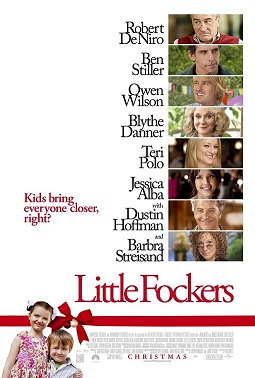
Little Fockers (2010)

After suffering a heart attack, a former CIA agent (Robert De Niro) prods his son in law (Ben Stiller) to prepare to take over as the head of the family. That's about it. The FOCKERS franchise has gone to the well once too often. It's dry as a bone. You can see where the jokes are supposed to be and that you're supposed to laugh but the situations are so lame that even a smile is asking too much. When the funniest bit is saved for the end credits, you know something has gone terribly awry. The first entry MEET THE PARENTS was first rate and the second MEET THE FOCKERS was a reasonably successful sequel. The third time trips them up. For some reason Owen Wilson, who was the most annoying character in MEET THE PARENTS, has been resurrected as if he were a highlight of the first installment! He gets strong competition in the annoying sweepstakes from Jessica Alba as the perky rep of a major drug company (Wilson wins). One cringes for the poor actors, surely they must have realized what poor material they were working with. Barbra Streisand and Dustin Hoffman are also back as Stiller's parents but they're wasted. Directed by Paul Weitz. With Laura Dern, Blythe Danner, Teri Polo and Harvey Keitel (one winces at his scenes with De Niro, a far fall from their glory days in TAXI DRIVER). I trust this has killed the franchise for good.

Rocky Mountain (1950)

Under secret orders by General Robert E. Lee, a Captain (Errol Flynn) leads a small group of Confederate soldiers into California with the intention of recruiting some renegades to fight on the side of the South. However, after rescuing a young woman (Patrice Wymore) and a stagecoach driver (Chubby Johnson) from an Indian attack, they find themselves trapped on a rocky mountain by Shoshone Indians. Directed by William Keighley (THE MAN WHO CAME TO DINNER), this neat little western defies the expected cliches (well, maybe not all of them). Flynn, for example, is used strictly as a determined soldier, leaving the romance to Wymore and Scott Forbes as her Cavalry lieutenant fiance. And the somber finale (a shot of a small dog looking among the dead for its master is heartbreaking) leaves the usual western heroics behind. Keighley manages to keep the tension quotient high and doesn't waste much. Handsomely shot in New Mexico in black and white by Ted McCord (TREASURE OF THE SIERRA MADRE), one can't help but wish they had shot it in Technicolor instead. Max Steiner whips up one of his better scores. If you're a westerns buff, you can't afford to miss this one. With Sheb Wooley and Slim Pickens.

Friday, August 5, 2011

The Merchant Of Venice (1972)

In 14th century Venice, a young but poor noble (Christopher Gable) asks his anti-Semitic friend (Charles Gray) for a loan. Since he is cash poor until his ships come in, the friend agrees to loan the money but only if the young man is able to find a lender. A Jewish moneylender (Frank Finlay) agrees to provide the funds but demands a pound of Gray's flesh, literally, if the loan is forfeited. Of all Shakespeare's plays, I've always found THE MERCHANT OF VENICE the most disturbing because of its underlying anti-semitism. Though productions in recent decades have attempted to turn Shylock, the Jewish moneylender, into a sympathetic character, the text is still problematic. Though the other characters heap verbal abuse (including spitting on him) for his religion, he's the one who's humiliated and forced by law to convert to Christianity and all this with no irony! Meanwhile, the Gentiles all live happily ever after. All that aside, this is a decent production highlighted by Juanita Waterson's elegant costuming and by two strong performances, Finlay as Shylock who manages to makes us understand his need for revenge and Maggie Smith as Portia, the object of Gable's affection. Directed by Cedric Messina.

Thursday, August 4, 2011

An Alligator Named Daisy (1955)

Against his will, an Englishman (Donald Sinden, MOGAMBO) finds himself the guardian of an abandoned alligator named Daisy. The alligator takes a shine to him and they bond but Daisy causes havoc among his household, his place of work and at a posh ball thrown by his fiancee's (Diana Dors) father (James Robertson Justice). Based on the novel by Charles Terrot and directed by J. Lee Thompson (CAPE FEAR). When one thinks of director Thompson, one thinks of films like GUNS OF NAVARONE, not cute animal comedies with songs. Nevertheless, it's hard to resist the likable reptile or the innocuous comedy that's built around her. Sinden is a rather pleasant presence but his leading ladies, the statuesque Dors and the auburn haired Jeannie Carson, brighten up the film. With Margaret Rutherford as a dotty pet shop owner who talks to animals, Stephen Boyd, Frankie Howerd, Stanley Holloway, Roland Culver, Joan Hickson (whose indignant piano customer is one of the film's comedic highlights) and Ernest Thesiger.

La Dolce Vita (1960)

To describe the "plot" of Federico Fellini's masterpiece LA DOLCE VITA as a series of anecdotes in the life of a tabloid journalist (Marcello Mastroianni) does it an injustice. One of the landmark films in cinema history, it marked a transition for Fellini from his modest "realistic" films like LA STRADA and NIGHTS OF CABIRIA to a more ambitious non-linear, even extravagant, style of film making. Many of Fellini's admirers prefer CABIRIA, LA STRADA or even his later AMARCORD and it's understandable. There's an underlying sentiment in those films which make it easier to digest. It doesn't exist in nor has a place in the bleak universe of LA DOLCE VITA which focuses on sterile artists and intellectuals, aimless bourgeoisie and an increasingly soulless society. It's that rare film that justifies its lengthy running time (3 hours) yet there's not a bit of padding to it. The wide screen TotalScope (Fellini's first in the wide screen format) images by Otello Martelli is among the greatest B&W cinematography I've seen and praise must be given to Nino Rota's superb score. I've seen LA DOLCE VITA several times before and each time I'm near astonished at the depth and breadth of it. To discuss it properly requires more space than I have here. The amazing cast includes Anouk Aimee, Anita Ekberg, Yvonne Furneaux, Magali Noel, Nadia Gray, Alain Cuny, Jacques Sernas, Lex Barker, Annibale Ninchi, Audrey McDonald and Nico.

Wednesday, August 3, 2011

City Of Bad Men (1953)

In Carson City, Nevada during a world championship prize fight between Bob Fitzsimmons (Gil Perkins) and "Gentleman Jim" Corbett (John Daheim), a gang rides into town with the intention of robbing the proceeds of the fight. Unfortunately, their leader (Dale Robertson) finds that two other rival gangs have the same idea. Directed by Harmon Jones (GORILLA AT LARGE), the film's plot sounds interesting enough to expect an intriguing western and while it holds our attention, the execution is limp though the actual robbery during the fight is handled very well. As usual, Richard Boone makes for a compelling villain but the film's subplot featuring the usual good girl and bad girl vying for the hero slows the action down. Jeanne Crain as the good girl looks ravishing in Technicolor but despite being top billed, there's isn't anything for her to do but fret. Carole Mathews (SWAMP WOMEN) as the bad girl fares somewhat better. With the exception of a rousing main title, Cyril J. Mockridge's score is forgettable. With Lloyd Bridges, Carl Betz, James Best, Leo Gordon, Rodolfo Acosta, Don Haggerty and John Doucette.

Together Again (1944)

A prim and proper New England mayor (Irene Dunne) goes to New York to interview a free spirited sculptor (Charles Boyer) about a sculpture of her deceased husband for the town square but she finds him unacceptable. However, when a nightclub is raided, she's mistaken for a stripper and put in jail. The sculptor, who's fallen for her, blackmails her into hiring him lest he reveal the scandal. Directed by Charles Vidor (GILDA). As displayed in LOVE AFFAIR, Dunne (looking quite lovely here) and Boyer have a nice rapport and I've always preferred Dunne in her romantic and screwball comedies to her tearjerkers where she's just insufferable. Alas, as romantic comedies go, this is a pretty pallid affair. Everyone dutifully goes through their paces but there's no sparks. It's watchable but when it's over, you have to struggle to remember it. With Mona Freeman as Dunne's precocious daughter, Charles Coburn, Janis Carter, Charles Dingle, Elizabeth Patterson and the gangling Jerome Courtland, who would quit acting for a directing career on such prime time soaps as DYNASTY, FALCON CREST and KNOT'S LANDING.