Search This Blog

Friday, December 30, 2011

Summer Holiday (1948)

Set in the turn of the century small town Connecticut, a young boy (Mickey Rooney) graduating from high school struggles with puppy love and Marxist philosophies during the summer. This musical version of the Eugene O'Neill play AH, WILDERNESS! is quite charming in its depiction of small town Americana. For some reason, it's not a very well liked musical but I found its nostalgic simplicity endearing. Certainly it's not a great musical. The songs by Harry Warren and Ralph Blane aren't very memorable but they work quite well in the context of the film. The director, Rouben Mamoulian, handles the musical numbers ably enough and there's a marvelous sequence where Rooney picks up a floozy (Marilyn Maxwell) and takes her to a bar and as he gets drunker, she becomes more attractive. With the exception of Gloria DeHaven as Rooney's romantic interest and Maxwell, the rest of the cast aren't singers but they do very well with their talking songs in a style later perfected by Rex Harrison in MY FAIR LADY. The cast includes Walter Huston, Agnes Moorehead, Frank Morgan, Selena Royle, Butch Jenkins and Anne Francis.

Death Of A Scoundrel (1956)

After a wealthy financial genius (George Sanders) is found murdered, his rise and fall from a Czech emigre to ruthless businessman is recounted in flashback by the woman (Yvonne De Carlo) who knew him best. Written and directed by Charles Martin, this very black comedy (though I'm not sure it was intended as such) is quite entertaining. No one was better at playing a cad than George Sanders and this is surely his ultimate cad role. Lying, swindling, stealing, blackmailing and climbing his way to the top on the backs of several women and relishing it every step of the way without a conscience. The film gets all pious toward the end with its sermonizing but the journey there is wicked fun. The handsome B&W cinematography is by the great James Wong Howe (PICNIC) with a lazy, generic score by Max Steiner. The cast includes Zsa Zsa Gabor (the ex-Mrs. George Sanders), Coleen Gray, Nancy Gates, Victor Jory, John Hoyt, Werner Klemperer, Tom Conway (Sanders' real life brother playing his brother), Lisa Ferraday, Celia Lovsky, John Sutton, Morris Ankrum and George Brent whose part has been eliminated to the point of being a background player.

Thursday, December 29, 2011

Life At The Top (1965)

After marrying the boss's daughter (Jean Simmons) in his climb up the ladder of success, a man (Laurence Harvey) finds that life at the top isn't what he wants after all. Based on the novel by John Braine and directed by Ted Kotcheff (WEEKEND AT BERNIE'S). Six years after ROOM AT THE TOP, this sequel shows the protagonist's disillusionment and disgust with the hypocrisy and emptiness of his chosen life. Harvey recreates his Joe Lampton from the earlier film but Jean Simmons replaces Heather Sears. As far as sequels go, this one is very good and Harvey manages to rouse himself out of his usual wooden stupor and actually give a performance. But his character's self pitying and whining hypocrisy, he has contempt for his upper class associates but he's reluctant to give up his comfortable lifestyle, begin to grate after awhile. When Simmons has an affair with another man (Michael Craig), our sympathies are entirely with her. There's a fine subtle score by Richard Addinsell. With Honor Blackman (who steals the movie) as a TV commentator who has an affair with Harvey, Donald Wolfit (who has the remarkable ability to overact while standing perfectly still), Robert Morley, Nigel Davenport, Margaret Johnston, Edward Fox, Allan Cuthbertson, Denis Quilley and Geoffrey Bayldon.

Wednesday, December 28, 2011

Bombay Talkie (1970)

A self centered, neurotic British writer (Jennifer Kendal) while visiting India has an affair with a married Bollywood star (Shashi Kapoor, married to Kendal in real life) who is equally vapid and selfish. Directed by James Ivory (A ROOM WITH A VIEW) and his usual team, producer Ismail Merchant and screenwriter Ruth Prawer Jhabvala, this is a rather tedious film with two unappealing characters getting together, breaking up, getting together again etc. for almost two hours until we no longer give a damn. They're so unlikable that they deserve each other but almost all of the characters in the film, including Kapoor's cuckolded wife (Aparna Sen), are so insipid that one can't feel any empathy for any of them. There is one exception: An aging Bollywood actress with a penchant for younger men played by Nadira who has more life in her than anyone else in the film. The film's opening credit sequence is clever with billboards around the city listing the film's credits along with drawings of its actors and crew. With Zia Mohyeddin, Utpal Dutt and the ubiquitous Helen, known as the Queen Of The Nautch Girls (she's appeared in over 500 films), in the film's amusing giant typewriter dance sequence.

Serenade (1956)

An aspiring opera singer (Mario Lanza, looking bloated) is discovered singing in a cafe in San Francisco. A predatory and manipulative society maven (Joan Fontaine) with a penchant for discarding men when she gets bored with them, helps build his career only to destroy him. Based on the 1937 novel by James M. Cain and directed by Anthony Mann (BEND OF THE RIVER). The film bears very little resemblance to Cain's book. In the film, Lanza falls in love with a matador's daughter (Sarita Montiel) but in the book, her character is a prostitute and Fontaine's character is a gay male. Too sizzling for 1956 audiences hence the whitewashing. Director Anthony Mann doesn't seem much interested in the proceedings nor the extended musicals sequences for Lanza's comeback vehicle (this was his first film in four years). The part, even if seemingly tailored for Lanza here, makes demands on Lanza as an actor that he is ill equipped to fulfill satisfactorily. Even in his singing, he seems to be trying too hard though his rendition of Puccini's Nessun Dorma is lovely. With Vincent Price, Vince Edwards, Joseph Calleia, Edward Platt, Harry Bellaver and Licia Albanese who plays Desdemona to Lanza's OTELLO.

Tuesday, December 27, 2011

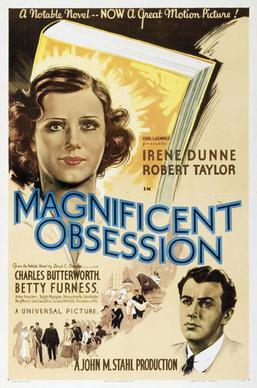
Magnificent Obsession (1935)

When a wealthy playboy's (Robert Taylor) life is saved by the hospital's only pulmotor (a resuscitator), a beloved and respected doctor dies because of the lack of the pulmotor. The doctor's widow (Irene Dunne) and daughter (Betty Furness) resent him but he falls in love with the widow. When she is blinded in an accident, he feels responsible and is determined to redeem himself. Based on the Lloyd C. Douglas (THE ROBE) best seller, the John M. Stahl film was remade with much more resonance and artistry in 1954 by Douglas Sirk. This version has an overly generous amount of humor (much of it provided by the annoying Charles Butterworth) which only dilutes the drama. The humor also provides an inconsistency in Dunne's character. One scene has her bitter and hating Taylor's character because he is alive while her husband died then in the next scene, they're all romcom cute in a car. Taylor is fine when he doesn't try to act but when he does, it's wincing and he's especially terrible when he tries to act drunk. The religious references and imagery are also much more overt than in the 1954 film. The undistinguished score is by Franz Waxman. With Sara Haden and Ralph Morgan.

Monday, December 26, 2011

The Chase (1966)

A small Texas town bubbles over with a mixture of fear, anger and excitement when news reaches the town that an escaped prisoner (Robert Redford) is on his way home. Several of the townspeople are particularly affected including his wife (Jane Fonda) who is having an affair with her husband's best friend (James Fox), his mother (Miriam Hopkins) who has a sense of guilt of how he turned out, the bank vice president (Robert Duvall) who stole some money but let Redford take the fall and the sheriff (Marlon Brando) who must try to keep law and order as racism and vigilantism rear their ugly heads. This underrated film was poorly received both critically and financially upon its initial release but the passage of time has been kind to the film and slowly, but surely, the film's reputation is growing and justifiably so. Directed by Arthur Penn with a screenplay by Lillian Hellman (THE LITTLE FOXES) from a play by Horton Foote, it's Tennessee Williams territory with its portrait of a Southern sexual and violent hothouse. The film doesn't temper either its sexuality (wife swapping seems the town's favorite sport) or violence (a scene of Brando being brutally beaten was quite graphic for its day). The score is by John Barry. The huge cast includes Angie Dickinson, Martha Hyer, E.G. Marshall, Janice Rule, Henry Hull, Diana Hyland, Richard Bradford, Bruce Cabot, Jocelyn Brando, Eduardo Ciannelli, Lori Martin, Pamela Curran, Malcolm Atterbury and Clifton James.

Mrs. Santa Claus (1996)

Feeling neglected, Mrs. Santa Claus (Angela Lansbury) decides to take the reindeer for a ride but has a breakdown over 1910 New York City in which Cupid the reindeer is injured. Waiting for Cupid to recuperate, she has an opportunity to interact with the working class citizens of Avenue A and plays matchmaker between a Jewish immigrant (Debra Wiseman) and an Italian immigrant (David Norona) and starts a worker's strike at a children's sweat shop. The Disneyesque musical seems a cross between NEWSIES and OLIVER! at times. The forgettable disposable score by Jerry Herman (MAME) feels like rejects he pulled out of his trunk. There is one catchy and lively musical number Avenue A choreographed by Rob Marshall (who would later go on to direct the film versions of CHICAGO and NINE). The acting is uncomfortably broad (in particular Terrence Mann's cartoonish villain) as if the director (Terry Hughes) thought we or most probably the child audience wouldn't respond to subtlety. But its heart is in the right place and Lansbury gives it her all, the lady's a trouper! With Charles Durning as Santa Claus, Lynsey Bartilson, Rosalind Harris (FIDDLER ON THE ROOF) and Michael Jeter.

Thursday, December 22, 2011

It Started With A Kiss (1959)

An Air Force sergeant (Glenn Ford) has a whirlwind romance with a dancer (Debbie Reynolds) in New York and they marry within 48 hours of knowing each other. But when he's shipped off to Spain and she joins him there, she realizes how little they really know each other and insists on a platonic marriage until they do. Directed by George Marshall (HOW THE WEST WAS WON), this bubbly adult comedy is quite open and frank about sex for its day (1959) and while not very original (one sequence is wholly lifted from Hawks' BRINGING UP BABY), it manages to be consistently amusing and Ford and Reynolds (who has a terrific scream) play off each other very well. Handsomely shot in CinemaScope by Robert Bronner (IT'S ALWAYS FAIR WEATHER) on location in Spain. One of the film's key "characters" is a hideous one-of-a-kind red automobile especially designed for the film which was later painted black and used for the Batmobile in the BATMAN TV show. With Eva Gabor, Gustavo Rojo, Fred Clark, Harry Morgan, Edgar Buchanan, Carmen Phillips, Joi Lansing, Richard Deacon and Frances Bavier.

Wednesday, December 21, 2011

The Homecoming (1971)

Set on Christmas Eve during the 1933 depression, a poor Virginia mountain woman (Patricia Neal) and her children await the arrival of the father (Andrew Duggan) who, because of a lack of jobs, works 50 miles away and must make his way home for Christmas through terrible weather conditions. But as the evening falls, he still isn't home and she begins to worry. Loosely based on the Earl Hamner Jr. novel SPENCER'S MOUNTAIN (previously filmed in 1963) and later adapted into the popular television series THE WALTONS. I never watched THE WALTONS but I certainly hope the show was better than this. It's all sentimentally country folksy and doesn't come across as real at all. In addition, the film is saddled with a roster of horrid child actors playing artificial children, the kind of youngsters that exist in only in the movies and not real life. The best part of the film is a visit by Richard Thomas and Cleavon Little on Christmas Eve to a pair of eccentric spinsters beautifully played by Josephine Hutchinson and Dorothy Stickney. Directed by Fiedler Cook and there's a lovely muted score by Jerry Goldsmith. With Edgar Bergen, Ellen Corby (who like Richard Thomas would go on to do THE WALTONS) and William Windom.

Tuesday, December 20, 2011

Saskatchewan (1954)

In Northern Canada in the 1870s, the native Cree in the Saskatchewan territory are in talks with the Sioux from across the U.S. border to join up against the North West Mounted Police. A Mountie (Alan Ladd) comes into conflict with his new commanding officer (Robert Douglas) regarding not only his handling of the Indian situation but his commanding skills in general. Beautifully shot in Technicolor (by John Seitz, DOUBLE INDEMNITY) on location in the state of Alberta in Canada, veteran director Raoul Walsh isn't able to patch together anything more than a routine western (or should I say Northern?). Shelley Winters, looking very zaftig, as a prisoner being extradited back to the U.S. on murder charges is Ladd's romantic interest but shrill as a Brooklyn hausfrau, she's like a fish out of water in a western. With Hugh O'Brian, J. Carrol Naish, Richard Long, Anthony Caruso and Jay Silverheels.

The International (2009)

A rogue Interpol agent (Clive Owen) and a Manhattan district attorney (Naomi Watts in a thankless role) join forces to investigate an international bank which funds terrorism and arms trading among other things. But the deeper they get into the case, the more they realize they are in over their heads. Tom Tykwer (RUN LOLA RUN) directed this disposable thriller. It's actually quite enjoyable as Tykwer plays into our negative feelings and paranoia about the banking industry but it's the kind of movie you won't remember the following week. There's nothing terribly wrong with it but while Tykwer manages to whip up some exciting scenes, it's style over substance. Nothing wrong with that but in this case the style isn't sufficient enough to override the film's routine plot line. The film's highpoint is an exciting, if far fetched, shoot out in the Guggenheim Museum in New York. As expected in a Tykwer (who also wrote the film's score) film, it's handsomely shot (by Frank Griebe, PARIS, JE T'AIME). With Armin Mueller-Stahl, Ulrich Thomsen, Brian F. O'Byrne and James Rebhorn.