Search This Blog

Friday, March 8, 2013

They Live By Night (1948)

Three men escape from a prison work farm and take refuge at a gas station owned by the brother (Will Wright) of one of the escaped men (Howard Da Silva). While Da Silva and the second prisoner (Jay C. Flippen) plan a robbery, the third escapee (Farley Granger) finds himself falling for the gas station owner's daughter (Cathy O'Donnell, BEST YEARS OF OUR LIVES). Nicholas Ray made his impressive directorial film debut with this "lovers on the run from the law" noir which presages BONNIE AND CLYDE with which it shares similarities. The emphasis is more on the romantic relationship of the naive young kids rather than the crime elements of the story. Granger and O'Donnell bring a touching innocence to their doomed pair while the rest of the cast bring a suitable sense of cynicism and/or weariness to their characters. The cinematographer George E. Diskant's expressive B&W images and Leigh Harline's musical shadings contribute to the film's apprehensive ambience. Based on Edward Anderson's novel THIEVES LIKE US which was filmed again in 1974 by Robert Altman. With Helen Craig and Ian Wolfe.

Thursday, March 7, 2013

The Golden Hawk (1952)

A 17th century French privateer (Sterling Hayden) sails the Caribbean seas in search of Spanish and English ships to plunder. On one such ship, he rescues a feisty maiden (Rhonda Fleming) who he underestimates. She is, in fact, a notorious lady pirate. An intense love/hate relationship ensues. Based on a novel by Frank Yerby (FOXES OF HARROW), this low budget Technicolor pirate adventure has enough twists to hold our interest but it never rises above routine swashbuckler fare. It's the kind of glossy potboiler where Hayden is French, Fleming is British and John Sutton (whose performance I'd take more seriously if he didn't remind me of Harvey Korman) is Spanish ... and no one has an accent! Perhaps the most interesting character is Helena Carter (INVADERS FROM MARS) as Sutton's spoiled bride, who finds her sexual and emotional allegiances shifting but she's not developed fully. But who watches pirate movies for character studies anyway? Directed by Sidney Salkow. With Michael Ansara and Donna Martell.

Lucky Star (1929)

Returning home from WWI with the loss of his legs, a veteran (Charles Farrell) befriends a rural farm girl (Janet Gaynor) with a penchant for dishonesty. Slowly, without realizing it, they find themselves falling in love. But there are two impediments. The girl's mother (Hedwiga Reicher) who doesn't want her daughter to marry a "cripple" and a deceitful womanizer (Guinn Williams, whose acting is unsubtle to put it mildly) who has plans of his own for the girl. The third collaboration of director Frank Borzage and actors Gaynor and Farrell starts off charmingly before it descends into hokey sentimentality in its final act. It's a pity because, not surprisingly, Gaynor and Farrell have a lovely chemistry and one roots for the two of them during the initial stage of the tender romance and they have some lovely moments like when he's washing her hair. But the film doesn't need the overly melodramatic sentimentalism we're spoon fed. Still, it's almost 2/3 of a good movie. With Paul Fix.

Wednesday, March 6, 2013

A Matter Of Time (1976)

In the 1950s (at least it looks like the 1950s), a young country girl (Liza Minnelli) moves to Rome to work as a maid in a hotel that has seen better days. It is there that she meets an aging Contessa (Ingrid Bergman), once a great beauty and a former courtesan, who lives in the past. The final film of the great Vincente Minnelli is a disjointed, awkward film which feels very old fashioned and not in a good way. To be fair, the film was taken away from him by the studio heads who did the final edit and Minnelli disowned the film. Honestly, I'm not sure there's a good movie in there but we'll never know but at least I would have liked the opportunity to see Minnelli's cut. So it's kind of hard to know where to place the blame. Proud papa Minnelli has Geoffrey Unsworth (MURDER ON THE ORIENT EXPRESS) light and shoot his daughter exquisitely, she's never looked more beautiful on the screen. But the film belongs to Bergman who manages to retain vestiges of a possibly great performance. The lovely score is by Nino Oliviero and the mediocre songs by Fred Kander and John Ebb. With Charles Boyer in his final film role, Isabella Rossellini in her first film role, Gabriele Ferzetti, Fernando Rey, Tina Aumont and Spiros Andros.

Tuesday, March 5, 2013

You Can Thank Me Later (1998)

In a Catholic hospital, a dysfunctional (with a capital D) Jewish family gathers together during the patriarch's major life threatening surgery. Accusations, anger, tears, deceit, secrets and sex rear their collective heads. If one didn't already know this was based on a play (HYPER ALLERGENIC by Oren Safdie), it's pretty easy to guess that it was. Almost the entire film is set in a hospital room and its corridors with B&W flashbacks with various family members in psychiatric therapy. It's a dramedy though it's more successful with the dramatic aspects than the comedic ones. The family's Jewishness is constantly emphasized (there's even a documentary on the Nazis playing in the background on the TV) and the family brings it up a lot, not to mention the Hebrew song over the end credits. This is in contrast to the Catholic hospital with priests (one of the sons sneaks into a confessional to talk to a priest) and nuns hovering, it's a world where Protestants don't exist! The characters are archetypes and stereotypes which limits the actors and Ellen Burstyn is no more convincing as a Jewish mother here than she was in REQUIEM FOR A DREAM. Two actresses manage to break through though. Genevieve Bujold as the dying man's mistress masquerading as a nun and especially Amanda Plummer (an actress who deserved a better career) who brings an authentic sensitivity and quirky likability as the patronized daughter. The film doesn't work but you can't look away. Directed by Shimon Dotan. With Mary McDonnell, Ted Levine (SILENCE OF THE LAMBS), Mark Blum, Jacob Tierney and Roc LaFortune.

Monday, March 4, 2013

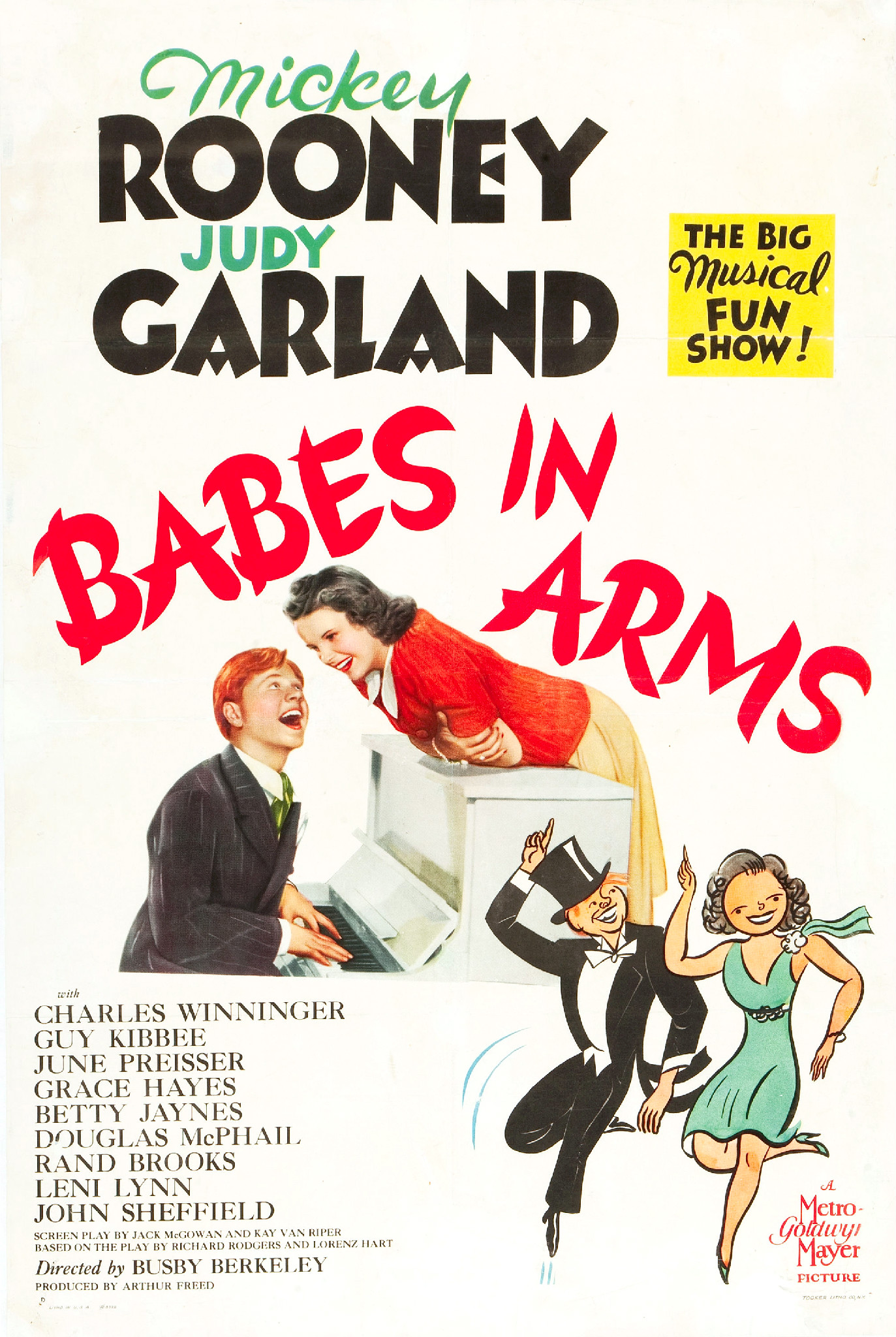
Babes In Arms (1939)

The son (Mickey Rooney) of ex-vaudevillians has show business in his blood. He decides to round up the kids of other ex-vaudevillians and put on a show in a rented barn where they can all be discovered and sent to Broadway. Based on the Rodgers and Hart musical, the film version tossed out all of the score except Babes In Arms and Where Or When. Missing in action are such hits as My Funny Valentine, The Lady Is A Tramp, Johnny One Note and I Wish I Were In Love Again. This hokey bit of piffle has its charms, mainly because of the kinetic Rooney (though his Oscar nomination for this film is puzzling) who gets a chance to show his talent for mimicry and bubbly Judy Garland, but parts of it positively creak. And while I understand times were different, it's hard to watch the minstrel number with Rooney and Garland in blackface and I could have done without the big flag waving patriotic finale. The energetic direction is by Busby Berkeley. With Charles Winninger, Guy Kibbee, Margaret Hamilton, Henry Hull, Ann Shoemaker, Betty Jaynes, Douglas McPhail and the rubber limbed June Preisser.

Sunday, March 3, 2013

Stoker (2013)

After the sudden death of her father (Dermot Mulroney), a young girl (Mia Wasikowska) is perturbed when an uncle (Matthew Goode) she never knew she had moves in. She is even more disturbed when her mother (Nicole Kidman), barely grieving over the death of her husband, doesn't bother to hide her attraction to Uncle Charlie. That the character is named Uncle Charlie tips us off early on that this is a homage to Hitchcock's SHADOW OF A DOUBT. But whereas the niece in Hitchcock's film was a wholesome innocent who welcomed her uncle until she discovered his sinister secret, the niece here is no innocent but a loner who resents her uncle's presence until to her horror she discovers, she is indeed her uncle's niece. The first English language film by the Korean director Chan-wook Park (OLDBOY), is a darkly disturbing mixture of sexual discovery and violence (too bad the title THERE WILL BE BLOOD was already taken). There are hints of other influences like De Palma's CARRIE and vampire novels (the film's title is borrowed from Bram) yet the film remains original taking us down a corridor while familiar, we've never walked down before. Goode manages to make Uncle Charlie both repulsive yet fascinating, the lure of unadulterated evil and I continue to be in awe of Kidman's career choices. She batted it out of the ballpark as the Southern white trash prison groupie in last year's THE PAPERBOY and in a radically different performance as the upper crust matron of the manor who can barely disguise her dislike for her daughter, she is no less perfect. Written by the actor turned screenwriter Wentworth Miller (TV's PRISON BREAK), it's the first entry on my 2013 top ten and I suspect it will remain there. With Jacki Weaver (very good) and Phyllis Somerville.

Saturday, March 2, 2013

The Watcher In The Woods (1980)

A family consisting of a husband (David McCallum), wife (Carroll Baker) and two daughters (Lynn Holly Johnson, Kyle Richards) move into a secluded mansion near a vast forest. Something terrible happened almost thirty years ago that no one wants to talk about, the disappearance of a young girl (Katharine Levy) whose mother (Bette Davis) is the owner of the mansion the family has moved into. The oldest girl (Johnson) resembles the old woman's daughter and will prove key to solving the mystery of what happened 30 years ago. Based on the novel by Florence Engel Randall, the film starts out promisingly as a good old fashioned ghost story or mystery and it almost holds your interest for its first hour. But the film makers couldn't come up with a satisfactory ending and what they've provided is silly. Two alternate endings were shot and they are no more satisfactory, one with a more horror feel (an alien looking creature) and the other one with a more elaborate sci-fi ending. The original cut was around one hour and 45 minutes but the surviving print clocks in at a much shorter one hour and 23 minutes. Johnson (FOR YOUR EYES ONLY) is a pretty but vapid actress and not good enough to carry the lead. The others don't have much to do (Baker is eliminated in the current ending though featured prominently in the two alternates). Directed by John Hough (LEGEND OF HELL HOUSE) who intended a much darker film but was fought all the way by the studio (this is a Disney film) who didn't want to go there. With Ian Bannen, Georgina Hale and Dominic Guard (THE GO BETWEEN).

Neptune's Daughter (1949)

When her sister (Betty Garrett) becomes besotted with an Argentinean polo player, a swimsuit designer (Esther Williams) tries to break it up but finds her self attracted to the polo player (Ricardo Montalban) herself. What she doesn't know is that the sister is in love with a masseur (Red Skelton) pretending to be the polo player. Comedic complications ensue. One of the better Esther Williams vehicles, she actually spends very little time in the water here with only one underwater ballet at the very end of the film. So while Williams and Montalban provide the glamour and romance, Garrett and Skelton provide the laughs and Frank Loesser (GUYS AND DOLLS) provides the songs which include the Oscar winning hit, the delightful Baby, It's Cold Outside. But the musical highlight is the spectacular, frenetic Jungle Rhumba choreographed by Jack Donohue. It's all wrapped up in lush MGM Technicolor and pleasant all around. Directed by Edward Buzzell. With Keenan Wynn, Xavier Cugat, Ted De Corsia, Mike Mazurki, Joi Lansing, Theresa Harris, Sara Shane and Mel Blanc.

Jungfrukallan (aka The Virgin Spring) (1960)

In medieval Sweden, the spoiled if naive daughter (Birgitta Pettersson) of a prosperous farmer (Max Von Sydow) sets out to bring candles to her village's church. During her journey through the forest, she is accosted by two men (Axel Duberg, Tor Isedal) and a boy (Ove Porath) and raped and beaten to death. That evening, the rapists unknowingly seek shelter at the farmer's house. This disturbing and violent revenge piece is anomalous in director Ingmar Bergman's output. It has an almost Kurosawan feel to it and indeed I could see it as a Kurosawa film set in medieval Japan. But it still deals with Bergmanian themes like God, faith, guilt and the destruction of innocence. The winner of the 1960 Academy Award for foreign language film, the film has been influential in the horror genre in such films as LAST HOUSE ON THE LEFT and NIGHT TRAIN MURDERS, something I suspect Bergman may not have been thrilled about. As cinema, it's second tier Bergman but it is Bergman and demands attention. With Birgitta Valberg in the film's best performance as the victim's mother and Gunnel Lindblom.

Friday, March 1, 2013

Zulu Dawn (1979)

In January 1879 South Africa, British forces invade the Zulu empire in an attempt to crush their nation which is seen as a threat to the expansion of British colonialism. A prequel to the excellent 1964 film ZULU which documented the battle of Rorke's Drift which occurred after the massacre at Isandlwana which this film portrays, it's simply not as good. The 1964 film was able to concentrate on a very specific aspect which kept the anxiety factor high and its characters were better delineated. But the lengthy battle of Isandlwana is superbly done. In addition, it's difficult to sympathize with the arrogant, naive (or stupid if you prefer) Brits. Whatever one's thoughts on colonialism, you admired the courage of the British soldiers in ZULU. Here, they seem determined to muck everything up. Directed by Douglas Hickox (THEATRE OF BLOOD) and a stirring score by Elmer Bernstein. It's not the kind of film where the acting matters much but that's still no excuse for the awfulness of Ronald Lacey's performance. The large cast includes Burt Lancaster, Peter O'Toole, John Mills, Bob Hoskins, Simon Ward, Denholm Elliott, Nigel Davenport, Michael Jayston, Nicholas Clay, Freddie Jones, Simon Sabela, Christopher Cazenove and Phil Daniels (QUADROPHENIA).

Satan Met A Lady (1936)

A private detective (Warren William) is hired by a pretty blonde (Bette Davis) to find the man that jilted her. But when his partner (Porter Hall) is killed while following her, it becomes apparent that there's more to this case than meets the eye. Perfectly awful! This was the second of the three films made from Dashiell Hammett's THE MALTESE FALCON and it's been altered considerably. Rather than the hardboiled detective novel, it's been turned into a semi-screwball comedy, almost as if it were a parody skit of the original source material. At this stage in her career, Davis already had her breakthrough role with OF HUMAN BONDAGE and won an Academy Award for DANGEROUS yet clueless Warners was still casting her in drivel like this. No wonder she bolted the studio and fled to England. Directed by William Dieterle (1939's HUNCHBACK OF NOTRE DAME)), who doesn't even seem to be trying. With Marie Wilson, Alison Skipworth (in a gender reversal, she plays the Kasper Gutman role), Arthur Treacher and Wini Shaw.