Search This Blog
Saturday, March 30, 2013
Value For Money (1955)
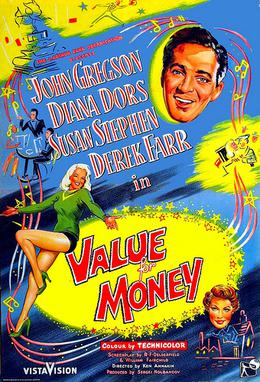
A young man (John Gregson) has inherited his father's rag business as well as his late father's "thrift" when it comes to spending money. His fiancee (Susan Stephen) refuses to commit to a wedding until he learns to loosen up, enjoy life and not be so tight fisted with his money. To this end, he goes to London where he meets a gold digging showgirl (Diana Dors) and falls in love. The sweet natured little comedy is a real charmer. I'm not fond of English comedies in general, especially 1950s British comedies but this one is hard to resist. The director Ken Annakin is perhaps better known for his big budget adventure films like Disney's SWISS FAMILY ROBINSON or BATTLE OF THE BULGE but he shows an unassuming talent for the genre. He never pushes too hard for the laughs, instead letting us just get the gag before quickly moving on. Dors, an underrated comedienne, looks spectacular. With Donald Pleasence, Joan Hickson, Ernest Thesiger and Ferdy Mayne.
Friday, March 29, 2013
The Mill And The Cross (2011)
The Flemish Renaissance painter Pieter Bruegel the Elder (Rutger Hauer) uses the procession to Mt. Calvary for the crucifixion of Christ as a metaphor for the religious persecution by the Spanish in mid-16th century Flanders in his painting THE PROCESSION TO CALVARY. This ascetic film, co-written and directed by the Polish film maker Lech Majewski (who also shared cinematography duties as well as co-writing the film score), is unique in its attempt to recreate an art form from another medium into cinematic terms without condescending to its audience. Alas, this also limits its audience for that very reason. It's a film that requires a certain amount of patience which will ultimately prove rewarding. It's a film meant for the eyes more than anything else and in that regard, the film can't be faulted. It's not a film where the acting matters a bit and Majewski could have used amateurs with the same results but in addition to Hauer, the cast includes Charlotte Rampling and Michael York.
Jigsaw (1949)
When a print shop owner is murdered, it's deemed a suicide. But a journalist (Myron McCormick, THE HUSTLER) believes the man was killed by a fascist racist organization. But when he is killed investigating into the matter, his best friend, an assistant D.A. (Franchot Tone), is determined to break the case wide open. This noir-ish thriller, like CROSSFIRE before it, attempts to meld a socially conscious statement with a hard boiled crime movie but is nowhere near as successful as that 1947 film. Directed by Fletcher Markle (Disney's THE INCREDIBLE JOURNEY), it's rather heavy handed in its message and rather obvious in its narrative. It's main asset is that it's economical in its story telling and gets it done in 73 minutes! Somehow the film's honorable intentions were enough to rope several big names into doing cameos: Henry Fonda as a snippy waiter, Burgess Meredith as a bartender, John Garfield as a smart aleck pedestrian, Marsha Hunt as a secretary and in an in joke, Marlene Dietrich in the audience of a nightclub called The Blue Angel. With Doe Avedon (THE HIGH AND THE MIGHTY) as the good girl, Jean Wallace as the femme fatale, Marc Lawrence and Robert Gist.
La Passante Du Sans Souci (1982)
A self made millionaire (Michel Piccoli) with a beautiful wife (Romy Schneider) is also the respected leader of an international organization for human rights (similar to Amnesty International). During an interview with the Paraguayan ambassador (Mathieu Carriere) regarding a political prisoner, he pulls out a gun and kills the ambassador. Once on trial, the events leading up to the murder which begins with his childhood in Nazi Germany unfolds. Based on the 1936 novel by Joseph Kessel (BELLE DE JOUR), director Jacques Rouffio's (he also co-wrote the script) film examines the correlation between Nazism in the 1930s and the rise of neo-Nazism in Europe in the late 70s. This is done by cutting back and forth between the modern day story and trial and 1930s events in Berlin and Paris and with Schneider playing two roles: Piccoli's wife in the contemporary segment and the woman who raised him in the 1930s story. It's a potent narrative to be sure but Rouffio bungles it with the extremities of his detail which seem over the top. This was Schneider's last film (she died a month after it opened and was nominated posthumously for a best actress Cesar award) and she doesn't look well. One can't be sure if it's simply aging or ill health. But her performance is very good. The subtle score is by Georges Delerue. With Maria Schell, Helmut Griem (CABARET), Gerard Klein, Dominique Labourier and as the young Piccoli, Wendelin Werner (whose only film this is, he went on to become a mathematical wizard).
Thursday, March 28, 2013
South Sea Woman (1953)
A U.S. Marine (Burt Lancaster) is being court martialed for desertion, destruction and theft during time of war. He refuses to defend himself and will not enter a plea. So it's up to a long legged showgirl (Virginia Mayo) to tell "his" side of the story on the witness stand. Loosely based on the play GENERAL COURT MARTIAL by William Rankin, this film would seem to have something for everybody: action, romance, comedy, patriotism, exotic locales etc. but by spreading itself too thin, it ends up unfocused. At first, it looks like a ROAD TO ..... clone with Lancaster, Mayo and Chuck Connors standing in for Crosby, Lamour and Hope. Then it gets all jingoistic on us as the trio attempts to sink a Japanese submarine from a stolen yacht. It's the kind of movie where when in the heat of battle a character attempts to hoist the American flag, you know there's a bullet waiting for him when he does it. The three leads give it their best and they're all fine but it's hardly worth the effort. Directed by Arthur Lubin (BUCK PRIVATES). With Paul Burke, Barry Kelley, Arthur Shields, Hayden Rorke and Bob Sweeney.
Wednesday, March 27, 2013
The Walking Stick (1970)
In Dreams (1999)
Evelyn Prentice (1934)
Monday, March 25, 2013
Two Weeks With Love (1950)
In the early 1900s, a middle class New York family takes their annual summer vacation in the Catskills mountains. This summer, however, the eldest daughter (Jane Powell) is on the verge of womanhood and resents being treated as a child by her parents. When a sophisticated Cuban (Ricardo Montalban) pays her some attention, she feels more misunderstood by her parents (Louis Calhern, Ann Harding) than ever. This piece of musical fluff is a genuine delight. While not on the level of a MEET ME IN ST. LOUIS, the film still has its charms, bathed in nostalgia and old fashioned family values. Powell is at her most likable here and while she does her usual classic light arias, she gets a chance to sing the jazzy ragtime Oceana Roll and wear a rosebud pink corset in a dream sequence. While Powell is the star though, it's the 7th billed young Debbie Reynolds that steals the movie. As Powell's sassy kid sister, she sings Abba Dabba Honeymoon and MGM realized she was no ordinary starlet and took notice and started putting her in leads. Powell stated this was her favorite of all her films at MGM and it's easy to see why. It would take a curmudgeon to resist it. Directed by Roy Rowland. With Phyllis Kirk (as a teen age vamp), Carleton Carpenter, Clinton Sundberg and Tommy Rettig.
Sunday, March 24, 2013
OSS 117: Rio Ne Repond Plus (aka OSS 117: Lost In Rio) (2009)
Set in 1967, a French secret agent (Jean Dujardin, THE ARTIST) is sent to Rio De Janeiro to retrieve a piece of microfilm from a Nazi (Rudiger Vogler) who escaped to Brazil after WWII. The microfilm is a list of French collaborators with the Nazis. Once in Rio, however, he is approached by the Israeli Mossad who aren't interested in the microfilm but want the Nazi to put on trial. Despite the serious synopsis, this is a comedy, a spoof of the international spy genre. A sequel to OSS 117: CAIRO, NEST OF SPIES, this one is only fitfully funny (Dujardin roasting a crocodile on a spit for dinner, an amusing nod to Hitchcock's NORTH BY NORTHWEST) and lacks the inspired hilarity of the first installment. Dujardin remains a real charmer, even if his character is a borderline chauvinist racist. The director Michel Hazanavicius gets the period look right, it looks like a 1967 film and Ludovic Bource's retro score is a delight. With Louise Monot, Alex Lutz, Ken Samuels and Reem Kherici.
The Sin Of Madelon Claudet (1931)
A young French farm girl (Helen Hayes in the first of her two Oscar wins) runs off with her American lover (Neil Hamilton) to Paris. After he abandons her, she finds herself pregnant. In order to support her child, she becomes the mistress of a wealthy older man (Lewis Stone) and from there descends to prostitution and thievery. Films about mothers who sacrifice their lives out of love for their children at whatever the costs were quite popular in the 1930s, STELLA DALLAS and MADAME X being the most notable examples. This one isn't as solid as the others but it benefits from a strong, if uneven, performance by Helen Hayes. Some of her performance is very actressy with lots of indicating as if she were doing a silent movie or theatrical as if she were on a stage rather than a soundstage. But she has many affecting moments too, mostly as the thieving harlot but also as the old Madelon. Directed by Edgar Selwyn. With Robert Young as the grown up son, Jean Hersholt, Karen Morley, Cliff Edwards, Alan Hale, Marie Prevost and Charles Winninger.
Saturday, March 23, 2013
The Human Voice (1966)
A middle aged woman (Ingrid Bergman) is distraught when her lover of several years breaks off their relationship to marry a younger woman. During a long telephone call late night, she tries to assure him that she is fine though it is clear that she is on the verge of a breakdown. Based on the 1930 play by Jean Cocteau, which had been filmed previously in 1948 by Roberto Rossellini with Anna Magnani as the woman, this is a tour de force in the hands of the right actress. It's a solo performance piece, an extended monologue, as the woman laughs, cries, lies, pleads and rages as she talks to her ex-lover (we never hear his end of the conversation). Without the right actress, it could easily become a tedious exercise. No surprise, Bergman is terrific, pushing it to the limit but never crossing over to bathos. A must for Bergman fans. Directed by Ted Kotcheff (FUN WITH DICK AND JANE).
Subscribe to:
Posts (Atom)
