Search This Blog
Tuesday, July 15, 2014
Cry Danger (1951)
Released after five years in prison for a crime he didn't commit, a man (Dick Powell) sets out to find those actually responsible for the crime. The directorial debut of Robert Parrish (IN THE FRENCH STYLE), this is a nifty little film noir rich with tension and anticipation. Powell is almost always at his hard boiled best in these noirs (MURDER MY SWEET, PITFALL) and he gets good support from the rest of the cast particularly Richard Erdman as an alcoholic war vet with a wooden leg. It's tight, fast paced and economical and if we're not entirely surprised when the big revelation comes, it's still a captivating slice of entertainment. Shot entirely on the streets of Los Angeles and not the most attractive parts either, Oscar winner Joseph F. Biroc's (TOWERING INFERNO) crisp black and white cinematography gives the film legitimacy. With Rhonda Fleming as Powell's ex-flame, William Conrad, Regis Toomey (as a detective, what else?), Kathleen Freeman and a showy performance by Jean Porter as a pickpocketing tart.
High Time (1960)
Against the wishes of his grown children, a self made millionaire (Bing Crosby) who owns a chain of restaurants decides to get the college education he never had. At first, he feels a little out of place but with the help of his young dormitory room mates, he soon fits in. Today, adults returning to colleges and universities to get or complete an education is pretty commonplace. But in 1960, it was still an unusual concept and in this lightweight Blake Edwards (THE PINK PANTHER) concoction, it's played for laughs. It's an amiable if mindless entertainment without much to recommend it unless you're a Bing Crosby fan which I'm not. The rest of the cast don't have much to do including Tuesday Weld whose screen time is minimal (even Fabian gets billed above her!). Nicole Maurey (DIARY OF A COUNTRY PRIEST) in a role turned down by Simone Signoret provides the laid back love interest as the French teacher. The score is by Edwards' frequent collaborator Henry Mancini but the musical highlight is the Oscar nominated song The Second Time Around (sung by Crosby) which became a frequently performed standard. Also in the cast: Richard Beymer, Gavin MacLeod, Yvonne Craig, Patrick Adiarte, Nina Shipman and Douglass Dumbrille.
Monday, July 14, 2014
Sylvia Scarlett (1935)
Sunday, July 13, 2014
Le Quai Des Brumes (aka Port Of Shadows) (1938)
La Venus A La Fourrure (aka Venus In Fur) (2013)
A theater director (Mathieu Amalric, THE DIVING BELL AND THE BUTTERFLY) is frustrated that he can't find the right actress for his new play, an adaptation of von Sacher-Masoch's 1870 S&M novel VENUS IN FUR. In walks in a rag doll of a ditzy actress (Emmanuelle Seigner) late for her audition and it's not long before the cat and mouse game begins and the tables turn. As he proved with DEATH AND THE MAIDEN and CARNAGE, Roman Polanski knows how to do filmed theater the right way! Based on the 2010 David Ives play, Polanski takes the thin material (the writing isn't very good, not having seen the play I can only assume it was a bore) and injects a mischievous playfulness to the proceedings. One can't take the play's underdeveloped ideas too seriously (and I don't think Polanski did either) but as a sly battle of the sexes, there's much fun to be had. Amalric looks so much like a younger Polanski that sometimes one forgets that it isn't Polanski! Seigner is marvelous here, teasing the audience as much as she's teasing Amalric and seducing both him and us all the while. The nicely subtle score is by Alexandre Desplat.
Saturday, July 12, 2014
One Touch Of Venus (1955)
A recently uncovered statue of the Roman goddess Venus (Janet Blair, BURN WITCH BURN) arrives at a New York museum after being purchased by a millionaire (George Gaynes). But when a barber (Russell Nype) places a ring intended for his fiancee (Mildred Trares), the statue comes to life and causes havoc. The 1948 film version with Ava Gardner gutted all the charming Kurt Weill and Ogden Nash songs save about three songs including the show's breakout hit, Speak Low. This production restores all the cut songs and is more faithful to the original 1943 Broadway show. As a Venus, Janet Blair is no Ava Gardner but she sings (Gardner was dubbed) and dances and gives a delightful performance. S.J. Perelman's and Ogden Nash's book retains the wit and appeal that was misguidedly revamped for the 1948 film. As an archival record of the original stage production, this is a keeper. Directed by George Schaefer. With Laurel Shelby, Iggie Wolfington and Louis Nye.
Breakfast Of Champions (1999)
How Awful About Allan (1970)
A young man (Anthony Perkins) returns home from a hospital following the death of his father (Kent Smith) in a fire which also disfigured his sister's (Julie Harris) face. The trauma causes a psychosomatic blindness in the young man. But when a mysterious college student rents a room in the house, he becomes paranoid that the boarder wants to do him harm. Based on the novel by Henry Farrell (WHATEVER HAPPENED TO BABY JANE?), this is a neatly done thriller if rather obvious. Since we only see the student through the protagonist's blurry vision, we know the film makers don't want us to see the boarder for a reason. The director Curtis Harrington specialized in these horror melodramas like WHAT'S THE MATTER WITH HELEN? and GAMES and he keeps the creepy ambience moving along nicely with solid performances by Perkins and Harris though Perkins at this point in his career could do this kinds of parts blindfolded. The weak underscore is by Laurence Rosenthal (THE MIRACLE WORKER). With Joan Hackett and Robert H. Harris.
Friday, July 11, 2014
Sometimes A Great Notion (1971)
A group of Oregon loggers go on strike demanding the same pay for shorter hours. They are backed up by their union. But the independent Stamper family lead by its cantankerous patriarch (Henry Fonda) and his eldest son (Paul Newman, who also directed) refuse to honor the strike and continue to supply the mill owners with logs. Based on the Ken Kesey (ONE FLEW OVER THE CUCKOO'S NEST) novel, the film is a paean to the rugged individualist. But the Stamper family are a rather arrogant and unlikable bunch so its hard to drum up much empathy for the tragedies and hardships that befall them. I suppose it's to the film's credit that it doesn't attempt to soften them up in order to make them more sympathetic but when the eldest son's wife (Lee Remick) finally decides she's had enough and leaves him, you totally understand why. Fonda seems rather miscast as a rugged womanizing right wing lumberjack (John Wayne would have been perfect) but Newman manages overcome his miscasting with an effective performance. The scene stealer in the movie is Richard Jaeckel who has one of those once in a lifetime roles (like Ben Johnson's Sam in THE LAST PICTURE SHOW) that veteran actors who have been toiling in the business for years that finally gets them recognition. He earned a well deserved Oscar nomination but lost to Johnson for TLPS. The often majestic cinematography by Richard Moore (THE REIVERS) takes full advantage of the ripe Oregon landscapes. I'm less enthusiastic over Henry Mancini's ill advised country and western underscore, it's Oregon not Tennessee or Texas. With Michael Sarrazin, Linda Lawson and Joe Maross.
Darling (1965)
As she's being interviewed for a woman's magazine about her life, a woman (Julie Christie in her Oscar winning performance) chronicles her "glamorous" life from model to Princess and is not above distorting the facts to favor her. For the film's first hour, the film does a compelling job of documenting a shallow and aimless soul, a "celebrity" without any actual gift or talent. Remarkably, Christie does the near impossible, she makes an empty headed waif interesting. It's the dark side of Holly Golightly. Part of it is her performance and part of it is her, she's the real thing and her screen presence is potent. But as magnetic as she is, even she can't sustain the superficial character for an entire film. The film is populated with superficial characters and even those that aren't supposed to be, like Dirk Bogarde, come across as empty. So after awhile we realize no one is going to change or have an epiphany and the movie will end with everyone as trifling as they were at the beginning. Edgy in its day, some of the film's view of "decadence" today looks rather silly or quaint. Still, it was one of the seminal films of the 1960s. Directed by John Schlesinger, who himself was critical of the film in his later years. With Laurence Harvey, Jose Luis De Vilallonga and Roland Curram.
Thursday, July 10, 2014
Monsieur Beaucaire (1946)
King Louis XV of France (Reginald Owen) orders a member of his court, a Duke (Patric Knowles) who is the King's rival for the hand of Madame Pompadour (Hillary Brooke), to marry a Spanish Princess (Marjorie Reynolds) thus not only getting rid of him but the royal marriage between France and Spain will avoid a war. However, on the way to Spain the Duke switches places with his barber (Bob Hope) who must masquerade as the Duke at the Spanish court. Very loosely based on the 1900 novel by Booth Tarkington (MAGNIFICENT AMBERSONS) which was previously made as a swashbuckling silent with Rudolph Valentino, this is broad comedy with Hope dueling with wisecracks and quips rather than swords. He's in top form here whether setting up trysts with ladies of the court or trying to avoid a poisonous glass of wine during a toast to the King. The production values are impressive, so much so that it's a pity that the film was shot in B&W rather than Technicolor. It's silly but the script is good and Hope takes full advantage of the material. Directed by George Marshall. With Joan Caulfield, Joseph Schildkraut, Cecil Kellaway and Constance Collier.
Monday, July 7, 2014
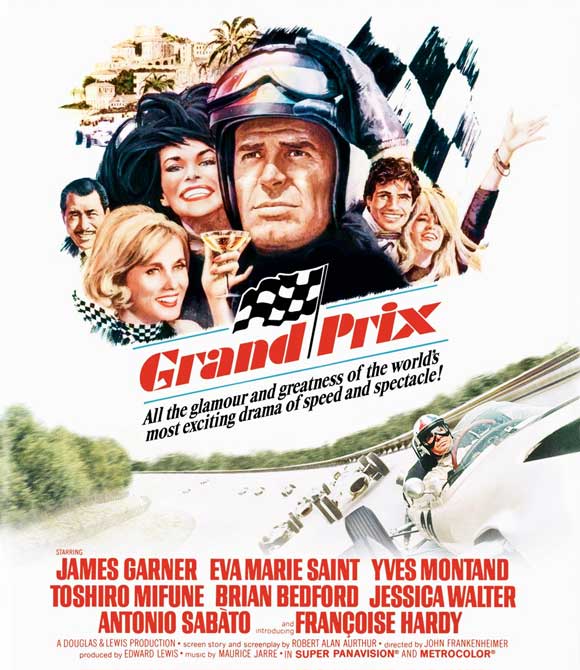
Grand Prix (1966)
During the Formula One racing season, four drivers are determined to become the world champion by the season's end. An American (James Garner), a Frenchman (Yves Montand), a Brit (Brian Bedford) and an Italian (Antonio Sabato). The film follows their wins and their setbacks, both professional and personal. Possible documentaries aside, this really is the greatest auto racing movie ever made. Oh sure, the film is littered with stock characters but the actors are good enough (it's amazing what Eva Marie Saint does with a nothing part) to compensate. The racing footage is stunning! The director John Frankenheimer puts us right into the seats and we can feel the rush of adrenaline while racing at a 100 plus miles per hour. The thrill of racing without actually having to do it! How he got some of that footage I don't know but no other racing movie before or since has equaled it. Lionel Lindon (THE MANCHURIAN CANDIDATE) gets the bravos for the awesome cinematography and giving credit where credit is due, the movie's film editors (Henry Berman, Stu Linder, Frank Santillo) did an awesome job. If it were made today, no doubt it would be filmed in 3D. With Toshiro Mifune, Jessica Walter, Genevieve Page, Francoise Hardy, Claude Dauphin, Adolfo Celi and Rachel Kempson.
Subscribe to:
Posts (Atom)
.jpg)