A psychologically disturbed woman (Elizabeth Taylor) travels to Rome to meet someone, someone she doesn't know but hopes to find. Someone who will murder her. Based on the critically acclaimed novel by Muriel Spark (PRIME OF MISS JEAN BRODIE), to call this movie bizarre is an understatement. I've not read the Spark novel but apparently it gave Taylor's character a backstory so that her shocking mission had some logic to it. The film gives no character history so she comes off as a wacko. The dialogue is almost impossible for the actors to say with any measure of believability, example: Ian Bannen "I have to have an orgasm a day for my macrobiotic diet" to which Taylor responds, "When I diet, I diet. When I orgasm, I orgasm. I don't mix the two". That being said, the film's horrendous reputation is unfair. The film remains a fascinating mess. One can see what the film makers were attempting, it just didn't come together. Taylor is good (one of her best post Virginia Woolf performances) though Bannen is too over the top to take seriously. Directed by Giuseppe Patroni Griffi. With Andy Warhol, Mona Washbourne, Maxence Malifort and Guido Mannari.

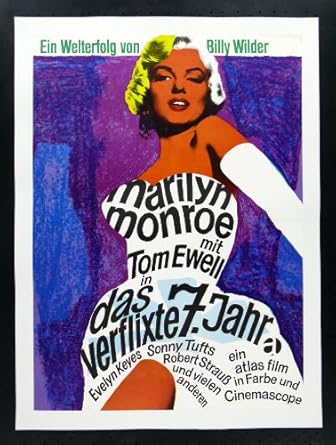
After sending his wife (Evelyn Keyes) and son (Butch Bernard) to Maine for the summer, a Manhattan publishing executive (Tom Ewell) finds himself attracted to the blonde (Marilyn Monroe) living upstairs. He contemplates adultery but can he go through with it? Based on the hit play by George Axelrod, who co-wrote the screenplay with its director Billy Wilder, the film suffers from not being able to shake off its theatrical origins. It's a theatrical device to have a character speak his thoughts out loud so the audience knows what he's thinking but in cinema, it comes across as artificial and unrealistic. Tom Ewell is recreating his stage role and he's just not an appealing screen actor. The film would sink under the weight of its own tediousness except for one thing ..... Monroe! Whenever she's on screen, she's so radiant that she lights everything up and even Ewell begins to seem tolerable. The film contains one of the most iconic images in all cinema, Monroe standing over a subway grate as her white halter dress billows up around her. With Carolyn Jones, Oscar Homolka, Marguerite Chapman, Sonny Tufts and Victor Moore.

It's summer and the Beach Party gang are up to their old tricks at the beach but a wealthy newspaper publisher (Keenan Wynn) wages an anti-surfer campaign in his newspaper. Meanwhile, a British Beatles like pop star (Frankie Avalon) threatens to steal the girlfriend (Annette Funicello) of our beach hero (Frankie Avalon). One of the weakest entries in the Beach Party franchise, this one is on auto control. The songs (except for Stevie Wonder) are a yawn and the jokes are lamer than usual and Harvey Lembeck's Von Zipper act was getting pretty tedious. And one has to wonder what Martha Hyer (she even has to kiss an ape) and Keenan Wynn are doing here. That "ape" is so obviously an actor in a monkey suit that one wonders how dim the characters are that they can't even notice! Directed by William Asher. With Boris Karloff, Don Rickles, John Ashley, Donna Loren, Jody McCrea, Candy Johnson, Meredith MacRae, Michael Nader and Timothy Carey.


A scientist (Hugh Marlowe, ALL ABOUT EVE) in charge of a space program is contacted by aliens from outer space. Their planet is dying and they want to colonize Earth. But how to stop them? This modestly entertaining piece of 1950s science fiction suffers from over earnestness. With the dullest of second tier leading men like Hugh Marlowe (where's Kenneth Tobey when you need him?) and poor Joan Taylor saddled with the drab "wife" role, the movie desperately needs an infusion of humor to leaven things out. Tim Burton's homage to EARTH VS. THE FLYING SAUCERS, the witty MARS ATTACKS succeeded in doing just that. The special effects work by the legendary Ray Harryhausen is noteworthy and the film isn't long enough for any lethargy to set in. Directed by Fred F. Sears. With Morris Ankrum, Donald Curtis and Thomas Browne Henry.
It's 1943 during WWII and at Pearl Harbor, a Navy submarine commander (Clark Gable) is currently holding a desk job after losing his submarine to a Japanese destroyer one year before. When he is given a new submarine command, there's only one thing on his mind ..... getting the Japanese destroyer that downed his submarine. Based on the novel by Edward L. Beach Jr., this is a tight and lean action film with no flabby subplots or extraneous romance (the only female in the film is Mary LaRoche briefly seen as Gable's wife) to hold it back. Directed by Robert Wise, the film is as focused as Gable's character in getting down to business. Once we're on the submarine, we're in there for the remainder of the film with no respite from the tension from either the ship's crew which threatens to snap at any minute nor the sub's dangerous mission. Only once did it falter: a minor character that may as well have had "I'm going to die before this movie is over" tattooed on his forehead! With Burt Lancaster as Gable's adversarial second in command, Jack Warden, Don Rickles, Brad Dexter and Joe Maross.


In the 1950s and 1960s, pop music took hold in Cambodia. First, there was the French influences (from Edith Piaf to Johnny Hallyday) but then came the English (Cliff Richard and the Shadows) and, of course, American. It was a fusion of American pop/rock and Afrro-Cuban (think Santana). The music scene thrived and created their own pop stars but when the Khmer Rouge took power, pop music wasn't merely censored, it was systematically dismantled (only "patriotic" songs were allowed) and many of the country's biggest stars were sent to forced labor camps. This fascinating and often moving documentary can't help but also include Southeast Asia's political turmoil (and U.S. involvement) in its influence on the music scene (U.S. soldiers introduced Cambodians to a lot of American rock). What film clearly shows is that Art will survive. You may even destroy the artist but you cannot destroy his Art. Art is influential so it is necessary for a fascist government to suppress or censor it but you can't destroy it. Alas, since so much actual footage of the artists was destroyed, the director John Pirozzi is often forced to use stills, repeated footage, voice overs etc. to recreate the era. Luckily, some of the artists survived to tell their story. Well worth seeking out.