Deciding to improve herself, a country girl (Sandra Dee) goes to a small college. While she finds it difficult to fit in with the rest of the student body, a handsome professor (John Gavin) and an elderly woman (Beulah Bondi) give her confidence. Based on the novel by Cid Ricketts Sumner and directed by Harry Keller (QUANTEZ). Sandra Dee takes over from Debbie Reynolds in the second of the three theatrical TAMMY movies. Dee isn't as comfortable in the role as Reynolds was as if she realized she wasn't convincing playing "country". The plot is threadbare with the most interesting aspect of the movie being the Beulah Bondi story line: an elderly woman confined by both her wealth, her bitterness and her money grubbing niece (Julia Meade) who finds a new lease on life living on a riverboat on the bayou. As the love interest, Gavin is as wooden as ever. He can't even laugh convincingly. With Charles Drake, Virginia Grey, Gigi Perreau, Stefanie Powers, Cecil Kellaway, Juanita Moore, Edgar Buchanan and Hayden Rorke.
A topnotch newspaper reporter (Rosalind Russell) is quitting her job to get married to an insurance salesman (Ralph Bellamy). But her editor (Cary Grant), who's also her ex-husband, dupes her into covering one more story on a condemned murderer (John Qualen). Based on the play THE FRONT PAGE by Ben Hecht and Charles MacArthur (previously filmed in 1931) and directed by Howard Hawks. In an inspired bit of rewriting, Hawks and his screenwriter Charles Lederer changed the gender of the male reporter in the original play thus giving the film the battle of the sexes angle and Russell the comedic peak of her career. She and Grant (also at his best) deliver the film's rapid fire dialog like thoroughbred champions. But Hawks has surrounded them with a cast of first rate character actors, all of them killing it. With all this frenetic activity, both verbal and physical, it's easy to underrate Bellamy's dupe. Screwball comedy doesn't get better than this! The perfect cast includes Gene Lockhart, Porter Hall, Ernest Truex, Roscoe Karns, Abner Biberman, Billy Gilbert, Helen Mack, Alma Kruger, Regis Toomey and Marion Martin.
Set in 18th century Spain, a child (Justin Walters) conceived in rape has blackouts but his guardian (Clifford Evans) discovers that during those blackouts, he turns into a wolf and slaughters animals. For awhile, those incidents stop but when he (now Oliver Reed) grows into manhood, they return. Based on the novel THE WEREWOLF OF PARIS by Guy Endore and directed by Hammer veteran Terence Fisher. The film begins with a lengthy and tedious exposition involving a beggar (Richard Wordsworth) and a mute servant girl (Yvonne Romain) that really doesn't have much relevance to the main narrative. Once it gets to the story proper, it becomes a stylish and graphically violent (the film was edited for its original British release) horror film. Wisely, we don't actually see the werewolf completely until the film's last 12 minutes or so which is just as well as the werewolf make up is disappointing. This was Reed's first starring role and his charisma and screen presence are already there. The score is by Benjamin Frankel (NIGHT OF THE IGUANA). With Catherine Feller, Anthony Dawson and Hira Talfrey.

A high school student (Koji Wada) studying in America is called back to Japan after his father's death. He is now head of his father's construction company. But he is suspicious about the circumstances surrounding his father's "accidental" death and sets out to prove not only was his father killed but who murdered him. Based on a story by Hara Kenzaburo and directed by Seijun Suzuki. I've seen most of Suzuki's major films and have loved or liked all of those I've seen. This one is a major disappointment. It's a curious blend of corporate espionage, high school teen comedy and even has some singing and dancing tossed in. Honestly, I'm quite at a loss what to make of it. But Suzuki was a contract director for Nikkatsu and TOKYO KNIGHTS was one of six films he churned out for Nikkatsu in 1961 alone! Judging from the end result, I'm just guessing it's not a film he was particularly interested in. While it's never boring, it's never engaging either and pretty silly actually. Needless to say, I had a hard time swallowing that a high school kid would be the corporate head of a major construction company! With Nobuo Kaneko, Mayumi Shimizu and Yoko Minamida.
A young boxer (Tony Wright) with a bright future is taken under the wing of a rich Italian (Frederick Valk) who sponsors him. But when he begins an affair with the Italian's hard-bitten wife (Barbara Payton), she pushes him to murder her husband. Based on the novel by Max Catto (DEVIL AT 4 O'CLOCK) and directed by Reginald Le Borg (THE MUMMY'S GHOST). This is your typical B noir set up. Gullible hero, manipulative femme fatale who lures him into her web and the good hearted husband with lots of money who stands in their way. In the mid 1950s, second tier American stars were sometimes imported to England to star in B movies so that the film would have some market value when they reached the States. Here, the minor starlet Barbara Payton serves that purpose. As cinema, it's predictable but mercifully short (1 hour, 20 minutes). There's not much you can say about a movie like this except been there, seen that. With Sidney James and John Slater.
.JPG)
A teenage girl (Ginger Rogers) runs away from a reform school and ends up in the hands of a Fagin like charlatan (Basil Rathbone, who steals the movie) who runs a school for pickpockets. When one of her victims (Adolphe Menjou) catches her trying to steal his pearl pin, he blackmails her into a scheme of his own. A remake of the 1940 French film BATTEMENT DE COEUR and directed by Sam Wood (KITTY FOYLE). In order for a romantic souffle like this to work, it needs a light touch and that Wood doesn't have (at least not here). But even if Wood had given the film the necessary sparkle, what really kills it is the miscasting of the 35 year old Rogers playing an 18 year old delinquent when she's the same age of her leading man, Jean Pierre Aumont. Watching Rogers act all childish and girlish is downright embarrassing. With Melville Cooper, Eduardo Ciannelli, Mikhail Rasumny and Mona Maris.
.JPG)
.JPG)
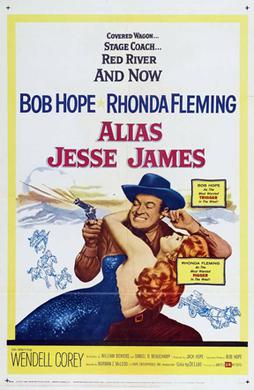
When an insurance agent (Bob Hope) mistakenly sells a $100,000 life insurance policy to the outlaw Jesse James (Wendell Corey), the company sends him to Missouri to get the policy back or stay there as long as necessary to keep James alive so he can't collect on the policy. Directed by Norman Z. McLeod. Two of Hope's best comedies were westerns, THE PALEFACE and SON OF PALEFACE. This effort isn't in their league but it's an innocuous divertissement. Rhonda Fleming provides the pulchritude and even joins Hope in a duet. If you're a Hope fan or a TV western buff, this should be right up your alley. The last five minutes are crammed with cameos from Gary Cooper, Bing Crosby, Roy Rogers, Hugh O'Brian, James Arness, Ward Bond, Fess Parker, Jay Silverheels and Gail Davis. Also in the cast: Gloria Talbott, Jim Davis, Scatman Crothers and Will Wright.
.JPG)
When the woman (Lizabeth Scott) he loves rejects him, a plastic surgeon (Paul Henreid) gives her face to a disfigured habitual criminal (Mary Mackenzie before, Lizabeth Scott after) and marries her. But while she may have a new face, her behavior reverts back to her criminal tendencies. Directed by Terence Fisher, the intriguing premise of a disfigured criminal being rehabilitated by plastic surgery is hardly new to anyone who has seen the 1938 Swedish film A WOMAN'S FACE with Ingrid Bergman or its 1941 American remake with Joan Crawford. This pulp version is nowhere near the quality of those movies but its premise is so irresistible that you're tantalized anyway and it's a credible watch. No surprise, Lizabeth Scott is much more convincing as the ungrateful bitch than the noble concert pianist. Malcolm Arnold (SUDDENLY LAST SUMMER) did the underscore. With Andre Morell, Susan Stephen and Ambrosine Phillpotts.


.JPG)
.JPG)
.JPG)
.JPG)
.JPG)
