A New York bookie (Bob Hope) finds himself saddled with a little girl (Mary Jane Saunders) when her father leaves her as a collateral on a bet. The child's father (Paul Lees) is killed by a shifty gambler (Bruce Cabot) which leaves the girl an orphan. Based on a short story by Damon Runyon (previously filmed in 1934 with Shirley Temple) and directed by Sidney Lanfield. The role of Sorrowful Jones offers Bob Hope a role which requires a bit more acting than his usual wise cracking one liners persona and he does well. The film reverts to treacle as it marches to its conclusion which is a pity as the ride was quite enjoyable for the most part. Lucille Ball provides the romantic interest and they have a nice chemistry (they would go on to make three more films together). She's one of Hope's few leading ladies to hold her own with him rather than providing little more than window dressing. The film would be remade twice more in 1962 with Tony Curtis and 1980 with Walter Matthau. Also in the cast: William Demarest and Tom Pedi.

Set during a bleak and cold winter in upstate New York, a woman (Melissa Leo in an Oscar nominated performance) struggles to make ends meet and support her two sons (Charlie McDermott, James Reilly) after her husband abandons them. When she meets a Mohawk woman (Misty Upham), they embark on an illegal venture smuggling immigrants across the Canadian border into the U.S. Written and directed by Courtney Hunt, this gripping and gritty yarn takes us into a milieu rarely explored in mainstream cinema. There's an authenticity to the whole project so that it almost feels like you're watching a documentary. The film doesn't condescend to its poverty ridden protagonists as they might have been by a Hollywood treatment. Melissa Leo and Misty Upham give superb performances and one can believe the unlikely bonding between these two desperate women from different cultures. With Michael O'Keefe and Dylan Carusona.
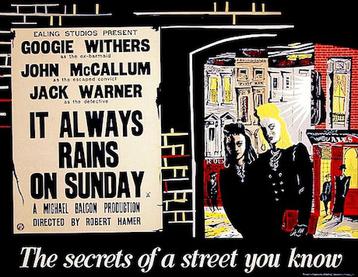
Set in post WWII London's East End, an escaped convict (John McCallum) seeks out an old flame (Googie Withers), who is now married and has a family, for a place to hide from the police. Based on the novel by Arthur La Bern and directed by Robert Hamer (KIND HEARTS AND CORONETS). This tough and gritty melodrama was a bit ahead of its time as it has the atmosphere of those British "kitchen sink" dramas that blossomed in the late 1950s and early 1960s. These aren't the posh Brits of BBC period dramas or Masterpiece Theater but the working class blokes and petty criminals. Almost every character in the film seems to be trapped in a cul-de-sac from which there is no escape. The film focuses mostly on the domestic entrapment of Googie Withers' wife but the movie also has a myriad of subplots involving bad marriages, cheating husbands, petty crooks, lechers and the police detective (Jack Warner) who weaves in and out of the story. While the film casts a bleak eye to its multiple characters, Douglas Slocombe's (THE LION IN WINTER) incisive B&W cinematography captures all the nuance and shading. With Edward Chapman, Susan Shaw, Patricia Plunkett, Sydney Tafler and Hermione Baddeley.
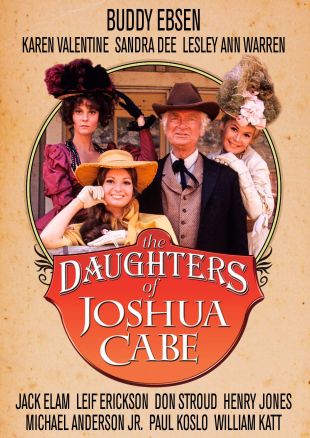
Due to an unusual homesteading law, an aging fur trapper (Buddy Ebsen) needs children to help him establish his claim on his property. To this end, he recruits three disreputable young women to pass off as his daughters: a prostitute (Lesley Ann Warren), a pickpocket (Sandra Dee) and an ex-convict (Karen Valentine). Directed by Philip Leacock (THE WAR LOVER), this contrived tale is moderately enjoyable thanks to Jack Elam as Ebsen's sidekick and the appealing presence of the three actresses playing the "daughters" which is good because Ebsen doesn't even try. There's a comfort in its predictability and you know your mind won't be taxed at all. It spawned two sequels in 1975 and 1976 but with different casts. With Don Stroud, Leif Erickson, Henry Jones, William Katt, Erin O'Brien Moore and Michael Anderson Jr.
Two one act plays by Tennessee Williams: Talk To Me Like The Rain And Let Me Listen (written in 1953) and I Can't Imagine Tomorrow (written in 1970). Each is a two character play in a single setting. All of the characters are broken people defeated by their circumstances, the cards that life has dealt them so to speak. In Talk To Me Like The Rain, an alcoholic (Alan Mixon) and a woman (Lois Smith) leading a life of quiet desperation cling to each other because they have no one else. In I Can't Imagine Tomorrow, a woman (Kim Stanley) who is dying tries to prepare her lover (William Redfield), who is figuratively dying for life without her. Neither are among Williams' best work but middling Tennessee Williams is still more fascinating than the "best" of most middling playwrights. Plus it gives us the rare opportunity to see the great Kim Stanley, whose filmed output is sadly minimal, act.
During the sexual revolution of the 1960s and 70s, a private college embarks on an experiment of students assigned to pre-selected room mates of the opposite sex and suggesting sexual intimacy. Based on the novel by Robert Rimmer and directed by Ted Post (HANG 'EM HIGH). This is a dumb movie that shows how cracked the 1960s could be. It seems to think it's being daring and seriously exploring contemporary mores but it's nothing more than an exploitation movie. James Whitmore and Tippi Hedren (as the college's founders) get above the title billing but their characters are peripheral to the action. The focus is on an annoying uptight virgin (Laurie Walters) partnered with a promiscuous Romeo (Don Johnson) but it makes no sense that her character would enroll in a progressive college exploring open sexuality. As a time capsule, it has some value showing where our heads were at in the 60s but as cinema, it's pretty much a dud. With Bruno Kirby and Robert Middleton.
A young dancer (Sally Forrest) with a promising career ahead of her is struck down in her prime with polio. Her fiance (Keefe Brasselle) sticks by her but she descends into a pit of self pity. Directed by Ida Lupino (herself a polio victim as a child), the film is one of those inspirational efforts that plays out like a Hallmark TV movie. Of course, there weren't TV movies in 1950 and I understand that its important subject matter was quite provocative for the time. But it's hard to watch a film with its central protagonist wallowing in self pity and while the lovely Sally Forrest is pert, she's not a strong enough actress to pull us into her psychological state. It's my least favorite of the Ida Lupino films I've seen (as a director). The grim subject matter didn't resonate with filmgoers in 1950 either. With Hugh O'Brian, Eve Miller, Lawrence Dobkin and Herb Butterfield.
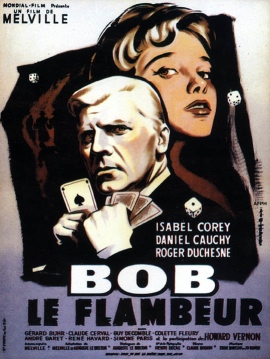
An aging gambler and ex-convict (Roger Duchesne) lives in the Montmartre district of Paris where he literally gambles his life away. When he hears that a Deauville casino will have 800 million in francs, he coerces his safecracker friend (Andre Garet) into helping him get a team of men to heist the casino's money, a plan that will have consequences for all concerned. Directed by Jean Pierre Melville, technically this could be called a heist movie along the lines of OCEAN'S ELEVEN or THE THOMAS CROWN AFFAIR. But it's not really the details of or the actual heist which is the focal point of the film. It's its myriad of characters and their place in this puzzle and their varied fates. Instead of a seamy and sordid atmosphere, Melville actually (whether he intended it or not) gives the whole process a sheen of allure and attraction. Disreputable never looked so glamorous. I had a minor problem believing that Duchesne's gambling addiction would cause him to forget something so crucial but then again I've never been addicted to gambling so I suppose it's possible. The film has a slight misogyny to it as two different women (the amoral Isabelle Corey, the conniving Colette Fleury) are responsible for unraveling the carefully thought out plans. Oh, did I mention that I was quite taken with it? With Daniel Cauchy, Guy Decomble and Claude Cerval.
While their father (Matthew Walker) is off serving as a chaplain in the Civil War, four sisters in Massachusetts live in genteel poverty along with their mother (Susan Sarandon): Jo (Winona Ryder in an Oscar nominated performance), Meg (Trini Alvarado), Beth (Claire Danes) and Amy (Kirsten Dunst who morphs into Samantha Mathis). Based on the beloved novel by Louisa May Alcott and directed by Gillian Armstrong. Considering its many adaptations for film, TV and the stage, timeless seems as good a word as any to describe LITTLE WOMEN. While not the definitive version (and not my favorite adaptation), the film is a scrupulously artful rendition of the novel. Warm and winning, the ensemble acting with a couple of exceptions is superior. I found Sarandon's Marmee out of place, perhaps too contemporary and Trini Alvarado's Meg rather benign. But those are minor quibbles. The atmospheric lensing of Geoffrey Simpson (SHINE), the art direction of Richard Hudolin and production design of Jan Roelfs and score by Thomas Newman (SKYFALL) all contribute to the movie's success. With Christian Bale, Gabriel Byrne, Eric Stoltz, Mary Wickes and John Neville.
A nine year old boy (Jasen Fisher) and his grandmother (Mai Zetterling) are staying at a seaside hotel in England when the hotel hosts a convention of witches lead by the Grand High Witch (Anjelica Huston). The witches (who look like ordinary women) plot to turn the world's children into mice! Based on the children's novel by Roald Dahl (CHARLIE AND THE CHOCOLATE FACTORY) and directed by Nicholas Roeg (DON'T LOOK NOW). This enchanting if dark fantasy was well received by the critics when it originally opened in 1990 but inexplicably, it was a failure at the box office. In the ensuing years, its reputation has grown and there's even a remake starring Anne Hathaway due out next year. While the film may be too frightening for very young children, ages 8 and up should be okay with it. Dahl was reputedly unhappy with the film's "happy" ending which differs from his book and I'm on his side. But other than that, this is an inventive lark of a movie that adults can enjoy every bit as much as kids. Huston gives a marvelous performance as the head witch, she seems to be having a ball being so wicked. With Rowan Atkinson, Jane Horrocks and Brenda Blethyn.
Set in Toronto, a nondescript bank teller (Elliott Gould) discovers his bank will soon be robbed. He begins siphoning the bank's money into his lunchbox so that when the robber (Christopher Plummer) eventually robs the bank, he won't get the money he knows has been deposited but instead get a meager amount. What the teller hadn't counted on is that the robber is a sadistic sociopath with homicidal tendencies and a cat and mouse came begins. Based on the novel THINK OF A NUMBER by Anders Bodelsen and adapted for the screen by Curtis Hanson (L.A. CONFIDENTIAL) and directed by Daryl Duke (THE THORN BIRDS). This is a terrific thriller! Hanson's screenplay is smart and precise without any fillers. It's pure suspense. The acting is first rate. Gould has never been more likable and Plummer's bat shit crazy villain sends shivers down your spine. This is not a man you want to cross. I could have done without one scene of gratuitous violence but other than that, the film is a gem of suspense. There's a nice underscore by Oscar Peterson. With Susannah York, John Candy and Celine Lomez as a femme fatale who seduces Gould.