Search This Blog

Saturday, November 23, 2013

Persona (1966)

When an actress (Liv Ullmann) has a breakdown and refuses to talk, literally, a young nurse (Bibi Andersson) accompanies her to a summer cottage by the sea where she is to recover. But there in the island's solitude, the two women find themselves feeding off each other. One of Ingmar Bergman's greatest films (some say his greatest), this is a fascinating film full of deceptively simple imagery yet often obvious symbolism. It's not Bergman at his most subtle (has he ever been?) but the man is a genuine Artist and when you're in the hands of a master at his very best, subtlety be damned! The secrets of PERSONA remain secrets to this day which is part of the reason the film resonates so powerfully still. One can guess, but only guess, at what Bergman is telling us. His film is open to so many interpretations that each new viewing reveals another nugget or two to ponder over and as sure as we may be about our own analysis, in the end, it's just that, our own ... not definitive. Andersson's performance is superb (her monologue on a sexual encounter on the beach is a tour de force) but Ullmann's equally dynamic performance may be overlooked because Andersson has all the dialogue. One of the great works of cinema.

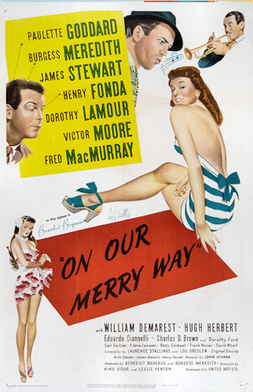
On Our Merry Way (1948)

A roving reporter (Burgess Meredith) canvasses the city with his question of the day, "How has a small child influenced your life?". What we get is three stories. The first is about two down and out musicians (James Stewart, Henry Fonda) who rig a talent contest expecting a big pay off but get the table turned on them instead. The second is about a film star (Dorothy Lamour) who specializes in exotic Polynesian heroines. The third (a steal from O. Henry's RANSOM OF RED CHIEF) is about two con men (Fred MacMurray, William Demarest) who encounter the kid from Hell (David Whorf) and plot to get money from his rich relatives. Co-directed by King Vidor and Leslie Fenton, this anthology comedy film is practically a footnote in the careers of everyone involved. While not exactly a jewel awaiting rediscovery, the film is a great deal of fun. Among the amusing highlights: James Stewart sucking a lemon, Henry Fonda getting drenched while playing a trumpet, Dorothy Lamour sending up her sarong image and MacMurray and Demarest mistaking a rope for a snake. All the actors so seem to be having a good time that it's infectious. The wrap around story involving Meredith and wife Paulette Goddard (in the film and real life) is the weakest segment. A decidedly minor but appreciated effort. With Harry James, Victor Moore, Eduardo Ciannelli, Carl Switzer and Dorothy Ford.

Thursday, November 21, 2013

Next Stop, Greenwich Village (1976)

In 1953, an aspiring actor (Lenny Baker, looking like a young Jerry Lewis) moves out of his parents' (Shelley Winters, Mike Kellin) Brooklyn home and moves to Greenwich Village to experience life. Director Paul Mazursky's autobiographical comedy is a valentine to Greenwich Village in the 1950s, to his Jewish parents, to the idiosyncratic artistic characters who populated his circle. Mazursky tweaks and skewers them but he's affectionate rather than condescending or mean spirited and we're swept up in his nostalgia, too. A rich tapestry of a place and time with bold strokes. And what performances! Shelley Winters as the quintessential Jewish mother gives one of her 2 or 3 best performances. She's a force of nature, barging in where she's not wanted and hysterically unraveling at what she perceives as a breach against decency. But you can't dislike her, she may be a monster but she's a loving monster. The undervalued Ellen Greene gives the film's most complex performance, a girl who wants to break out but only plays at being the Bohemian. The unobtrusive score is by Bill Conti. With Christopher Walken as a self centered "poet", Lois Smith, Jeff Goldblum, Antonio Fargas, Lou Jacobi, Dori Brenner and a young Bill Murray.

Wednesday, November 20, 2013

Code Two (1953)

Three police cadets (Ralph Meeker, Robert Horton, Jeff Richards) become friends during their training period at the Los Angeles Police Academy. All three end up as motorcycle cops but when one of them is murdered, the remaining two vow to find his killers. This low budget 70 minute quickie tossed out by MGM is tight and efficient though it plays out like a big screen version of the 1950s TV show HIGHWAY PATROL. It has a couple of shocking moments that stand out (a policeman's cold blooded killing, an acid bath for a criminal) that are pretty raw for a 1950s movie and it benefits from the L.A. location filming which gives it some realism. But overall, it's a "B" movie that does its job but nothing that pushes it out of the ordinary either. Still, you'll be entertained. Directed by Fred M. Wilcox (FORBIDDEN PLANET). With Keenan Wynn as the young cops' mentor, Sally Forrest, Elaine Stewart, Chuck Connors and William Campbell.

On An Island With You (1948)

Assigned as a technical adviser on a movie shooting in the South Pacific, a Navy Lieutenant (Peter Lawford) pursues the film's leading lady (Esther Williams) despite the fact that she's engaged to her leading man (Ricardo Montalban). How does one critique an Esther Williams movie? By the quality of her swimming numbers? This flimsy piece of Technicolor cotton candy is an amiable way of squandering a couple of hours but it offers nothing beyond the usual romantic mix-ups and Williams gracefully gliding through swimming tanks disguised as tropical lagoons. Cyd Charisse gets to do two dance numbers and Jimmy Durante milks the corniest jokes and, God bless him, still manages to make you laugh. Since this a 1940s MGM musical, of course, there's Xavier Cugat and his orchestra pounding out those Latin American rhythms. Oddly, the movie is inconsistent with the darker toned make-up sported by Williams' and Charisse when they play native island girls in the movie within the movie. In some scenes it's there and in other scenes, it's their natural skin tone. Florida substitutes for the South Pacific. Directed by Richard Thorpe. With Leon Ames, Marie Windsor, Dick Simmons and Betty Reilly.

Tuesday, November 19, 2013

Woman In A Dressing Gown (1957)

A rather slovenly working class housewife (Yvonne Mitchell) is content with her lot in life. In love with her husband (Anthony Quayle) and proud of her son (Andrew Ray), everything seems good. What she can't see is that her husband is unhappy in their marriage and in love with a younger woman (Sylvia Syms). Unless you're a Streep or a Nicholson, most working actors work to pay the bills and are lucky if they get that one role "of a lifetime" as it were. You may never get another great part again but you have that one performance and no one can ever take that away from you. The role of Amy Preston is Yvonne Mitchell's one great role and she is amazing! It's a part that some actresses would have done and gone all actress-y on us but Mitchell hits all the right notes (she won the best actress award at the Berlin film festival for her work here). She's touching, she's funny, she's annoying, she's real. The forerunner of all those British kitchen sink dramas like LOOK BACK IN ANGER and SATURDAY NIGHT AND SUNDAY MORNING, the director J. Lee Thompson (THE GUNS OF NAVARONE) gives us a gritty look at a working class marriage and how when our dreams never materialize, we still hope. I'm not sure how I feel about the film's ending. On one level, it seems like a total cop out but given the nature of its characters, it seems inevitable. With Carole Lesley and Marianne Stone.

Monday, November 18, 2013

Mr. North (1988)

In 1926 Newport, Rhode Island, a young man (Anthony Edwards) is hired to read the Bible to an ailing millionaire (Robert Mitchum) by his eccentric daughter (Tammy Grimes). But when the young man's ability to "shock" people by his touch due to the static electricity his body harnesses, rumors begin that he is able to heal by touch. Loosely based on the novel THEOPHILUS NORTH by Thornton Wilder (OUR TOWN), this should have been a whimsical fable but under Danny Huston's direction, it's like a souffle that keeps trying to rise and not succeeding. The character of Theophilus North should be charismatic enough to draw people toward him and Anthony Edwards exhibits no charm at all. In fact, he's the least interesting character in the film which is disastrous when the film is about him. The supporting characters are much more interesting. Robert Mitchum (in a role intended for John Huston till illness forced him to drop out) looks far too robust for a man in failing health but his presence is sorely needed in a movie like this. The delicate score is by David McHugh. The large cast includes Anjelica Huston, Lauren Bacall, Harry Dean Stanton, Mary Stuart Masterson, David Warner, Virginia Madsen, Katharine Houghton (GUESS WHO'S COMING TO DINNER?), Mark Metcalf and Christopher Durang.

Shack Out On 101 (1955)

At a small remote seaside diner off the 101 freeway in Southern California, suspicious activity is going on. Could it be ..... commies! This wacky B&W piece of anti-Red propaganda is far more entertaining than it has any right to be. Eschewing the heavy handed jingoism of films like BIG JIM MCLAIN, it works purely as a "B" thriller with some bizarre scenes like a homoerotic working out scene with a shirtless Lee Marvin and Keenan Wynn critiquing each other's bodies and the furious flag waving is saved for the very end. The director Edward Dein (THE LEECH WOMAN) co-wrote the screenplay with his wife Mildred and keeps the pleasing nonsense to a compact 80 minutes. The action is often pretty brutal as when Marvin slaps Terry Moore, as a sexy waitress, all around his room. Paul Dunlap did the jazz score. With Frank Lovejoy as the stalwart leading man, Frank DeKova and Whit Bissell as a man nauseated by violence so you just know before the movie is over, what he's going to be called upon to do.

Sunday, November 17, 2013

The Amazing Transparent Man (1960)

An ex-Army man (James Griffith) helps an inmate (Douglas Kennedy) escape from prison. His intention is have the escaped convict made invisible and steal the nuclear material needed to create and invisible Army to take over the world. Poor Edgar G. Ulmer! In the 1930s and 1940s, he was able to fashion some provocative "B" films on minimal budgets (THE BLACK CAT, DETOUR, THE STRANGE WOMAN) which gained him some stature among the auteurists. But by the 1950s, he was reduced to primarily to horribly inept low budget sci-fi schlock of which THE AMAZING TRANSPARENT MAN is a prime example. Clocking in at under an hour, it's essentially a piece of anti-Red propaganda disguised as science fiction. Sloppily put together, there's nothing of interest to recommend other than a fiery finale which presages KISS ME DEADLY. With Marguerite Chapman and Ivan Triesault.

Nebraska (2013)

When his aged alcoholic father (Bruce Dern) insists on going from Montana to Nebraska to collect his million dollar prize winnings from a contest, his wife (June Squibb) and son (Will Forte) attempt to explain to him that it's a scam. But when the befuddled old man demands to go, his son reluctantly accompanies him on the road trip. In many respects, this is a lovely film. Unlike his previous film THE DESCENDANTS (which I disliked intensely), director Alexander Payne doesn't ladle on the sentiment and the humor is restrained. It's only flaw is Payne's tendency to condescend to some of his rural characters. Other than that, it's a heartfelt yet keen look at a man nearing the end of a life filled with disappointments, the son who loves him and a gaggle of friends and family that suddenly get dollar signs in their eyes at the prospect of money. In many ways, it's like a male version of TRIP TO BOUNTIFUL and Bruce Dern (who won this year's best actor award at the Cannes film festival) gives a beautifully modulated performance. Will Forte, best known for his comedic work on SATURDAY NIGHT LIVE, also gives a dimensional performance and June Squibb as Dern's wife is a real scene stealer and provides the film's biggest laugh and applause moment. Handsomely shot in black and white widescreen by Phedon Papamichael. With Stacy Keach and Bob Odenkirk.

As I Lay Dying (2013)

When a Mississippi farm woman (Beth Grant) dies, her family honors her request to be buried in her people's town located several days away. As they undertake the journey of carrying her coffin by buckboard, everyone (including the deceased) reflects on their own aspirations, desires and feelings. William Faulkner's AS I LAY DYING is one of the great American novels. It is also among those literary works that defy being translated to film, unfilmable as it were. What makes Faulkner's book great is not necessarily its narrative but his technique, his style. The entire novel is a series of chapters, each complete chapter a stream of consciousness narrated by one character. That being said, director James Franco's (he also plays the second of the sons) film is probably as good a film of the Faulkner novel as we'll ever see. While his use of split screen as a visual device to approximate Faulkner's technique only partially works, there are still some impressive scenes (Beth Grant's monologue recalling her unhappy marriage and adulterous affair that spawned a son) that suggest the greatness of the novel. It bodes well for Franco's future as a director. The cast is perfect, they look like 1920s Mississippi farm people, not Hollywood actors and several of the actors deliver flawless performances: Grant, Tim Blake Nelson as her husband and Logan Marshall Green as the spawn of her affair. But it isn't Faulkner's novel, not really. The underscore by Tim O'Keefe is imposing. With Jim Parrack, Ahna O'Reilly, Brady Permenter and Danny McBride..

Saturday, November 16, 2013

The Decks Ran Red (1958)

The first mate (James Mason) on a luxury liner leaves his position to take command, his first as a Captain, of a New Zealand freighter. But his first command turns disastrous when a psychopathic crew member (Broderick Crawford) and his cohort (Stuart Whitman) start killing everyone on board. Allegedly based on an actual incident, the film's plot seems rather far fetched but that doesn't stop director Andrew L. Stone from creating a tension filled nail biter not unlike his THE LAST VOYAGE also set on an ill fated ship. It's not as good as THE LAST VOYAGE for several reasons, most notably because its ending is rather anti-climatic but the film benefits from a rather unpolished look to it. Mason seems a bit ill at ease as an action hero though Crawford is easily convincing as the murderous crewman. Dorothy Dandridge (CARMEN JONES) as the cook's sexy wife doesn't have much to do as a conventional heroine in distress but she looks fantastic. There's no film score but this is one film that could have used one to add a little needed flavor to the doings. With Jack Kruschen, Katharine Bard and Joel Fluellen.