Search This Blog
Monday, October 31, 2016
Duffy (1968)
Saturday, October 29, 2016
Stories Of Lost Souls (2005)
Hedda Gabler (1962)
Friday, October 28, 2016
Jackie (2016)
In 1963 shortly after the assassination of her husband (Caspar Phillipson), Jacqueline Kennedy (Natalie Portman) gives an interview to a reporter (Billy Crudup) for LIFE magazine reflecting on the death of her husband, his legacy, her legacy while we look at the period between the assassination and his funeral and her state of mind. Directed by Pablo Larrain, a Chilean director making his English language debut. It's difficult to assess this as cinema, as a film because it is so dominated by a single performance that defines the film and puts everything else in her shadow. The buzz on Portman's performance was very good but I was not prepared for the sheer brilliance of it. When playing real people who are known to the public, it can be a trap to do an imitation of the person rather than inhabiting them. Portman inhabits Jackie Kennedy. How accurate is the film? I don't know, I don't go to the movies for history lessons (and I hope no one else does either). It's clear that the film took artistic license. For example, one of the highlights of the film is a distraught Jackie listening to the cast album of CAMELOT while trying on different dresses and jewelry and wandering around an empty White House when obviously it would be filled with staffers and secret service during that period. Mica Levi's underscore is the best film score I've heard all year. With Peter Sarsgaard as Robert Kennedy, Greta Gerwig, John Hurt, Richard E. Grant, Max Casella, John Carroll Lynch and Beth Grant as Lyndon and Ladybird Johnson.
Thursday, October 27, 2016
The Swiss Conspiracy (1976)
A Touch Of Class (1973)
A chance meeting between a married American (George Segal) living in London and a British divorcee (Glenda Jackson) begins as an affair but becomes complicated when love enters the picture. Directed by Melvin Frank (THE COURT JESTER), this pedestrian "adult" romcom is probably most remembered today for Glenda Jackson's inexplicable Oscar win for best actress. Oh, it's sophisticated and fairly intelligent but it's also contrived. Naturally, Segal is given a nagging wife (Hildegard Neil) so the adultery can seem more sympathetic and while we see Jackson with her two children at the beginning, we never see them for the rest of the movie so we're not reminded that she's a mother although I couldn't help but think of the enormous babysitting tab she was running up while she sets up housekeeping and cooks Coq Au Vin suppers for her lover. Segal is an old hand at this type of thing but while Jackson proved she could do comedy with her hilarious cameo in THE BOY FRIEND, here she's rather brittle. Deadpan deliveries are one thing but some of her line readings are downright flat. With Paul Sorvino and K. Callan.
Wednesday, October 26, 2016
Island Of Lost Souls (1932)
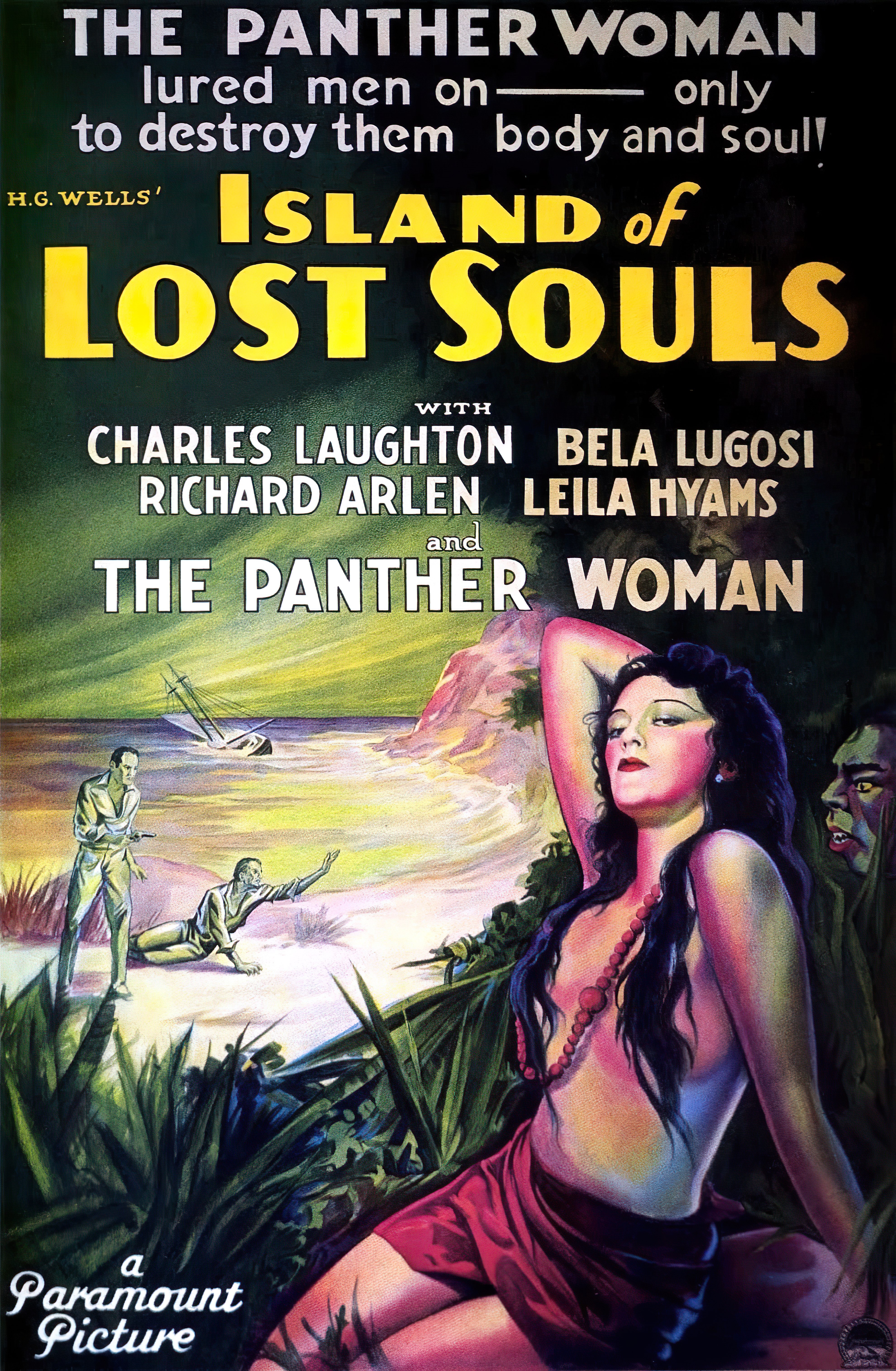
On his way to meet his fiancee (Leila Hyams), a man (Richard Arlen) finds himself stranded on a remote island after his ship is sunk. To his horror, he discovers that the doctor (Charles Laughton) who rules over the island with an iron fist is conducting ghastly experiments! Based on the 1896 novel by H.G. Wells and directed by Erle C. Kenton. Welles' novel has been remade officially twice, in the 70s with Burt Lancaster and the 90s with Marlon Brando. Unofficially, it's been ripped off many times. This pre-code version remains the most effective. Like Browning's FREAKS, it's an unsettling and disturbing piece of horror film making. Kudos must also go to Karl Struss's (Murnau's SUNRISE) expressionistic cinematography and the marvelous art direction by Hans Dreier. The acting is rather crude but Laughton brings a quiet malevolence to his delusional Dr. Moreau. This is the movie that coined the phrase, "The natives are restless tonight." With Kathleen Burke, Arthur Hohl and Bela Lugosi as the mutant Sayer Of The Law.
Il Buono, Il Brutto, Il Cattivo (aka The Good, The Bad And The Ugly) (1966)
During the Civil War between the states, three gunslingers known as the good (Clint Eastwood), the bad (Lee Van Cleef) and the ugly (Eli Wallach) work at odds with each other, sometimes in an uneasy alliance as they look for a graveyard where $200,000 in Confederate gold is hidden. Sergio Leone's epic western (3 hours long) wasn't embraced by mainstream critics when first released. The casualness of the violence and brutality was considered "vulgar" but audiences flocked to it and it paved the way for Peckinpah's WILD BUNCH. Today, the critical consensus is that it is one of the screen's great westerns. Of course, I've seen the film before but this time around I really appreciated Leone's use of the wide screen format (in collaboration with his cinematographer Tonino Delli Colli) which is stunning. Every frame a master composition that could hang on a museum wall. Leone's visuals are the thing here and very often there are long stretches of silence but the narrative continues, dialog isn't missed. Ennio Morricone's score is one of the best film scores ever written and it becomes as important a character as the three leads. The "ecstasy of gold" sequence which runs about 6 minutes with no dialog, just Morricone's score accompanying Wallach's search for the grave is justifiably famous. Speaking of Wallach, his performance is terrific and he really should have been nominated for an Oscar (movies like this weren't considered Oscar material) and he would be today! With Luigi Pistilli and Chelo Alonso.
Tuesday, October 25, 2016
The Holcroft Covenant (1985)
Les Amants De Verona (aka The Lovers Of Verona) (1949)
Monday, October 24, 2016
Fallen Angel (1945)
A drifter (Dana Andrews) arrives in a small California coastal town and immediately gets the hots for a sexy but cold hearted waitress (Linda Darnell at her sluttiest). He concocts a plan to marry a well off spinster (Alice Faye), get her money, dump her and marry the waitress. But when murder enters the picture, he's the prime suspect! Based on the novel by Marty Holland and directed by Otto Preminger. This B&W noir may not have the reputation of his LAURA but it's still pretty good. This was when Preminger still made tight economical features before the bloat set in during the late 1950s. Unfortunately when Darnell leaves the picture, some of the film's juice goes with her. Faye's angelic understanding doormat is no substitute for Darnell's sultry femme fatale. Though it's well done, as a whodunit it's on the weaker side as the element of surprise is missing for it's not too difficult to guess the murderer. The moody cinematography is by Joseph LaShelle (THE APARTMENT) and the underscore by David Raksin (LAURA) gives the film a needed lift. Faye left the movies after this film and wouldn't make another movie for 17 years. With Charles Bickford, Anne Revere, Percy Kilbride and Bruce Cabot.
Calling Bulldog Drummond (1951)
Subscribe to:
Posts (Atom)