
When an impoverished family inherits a ramshackle mansion from an occultist uncle, they find they've also inherited the house's ghosts and a housekeeper (Margaret Hamilton) who may be a witch. Directed by schlockmeister William Castle (STRAIT JACKET), this is an old fashioned family friendly ghost movie that could easily have come out of the 1940s. Castle gussied it up for its theatrical release with a gimmick of special glasses that would allow the audiences to see the ghosts (the process was called Illusion-O). The movie doesn't need the gimmick and works perfectly well without it. Being a wholesome ghost movie has it drawbacks however. It means that it's not very scary and outside of a gruesome death for the film's bad guy, this is a movie you could show to your kids. Poorly remade in 2001. With Donald Woods, Rosemary DeCamp, John Van Dreelen, the fetching Jo Morrow and that annoying child actor, Charles Herbert.
.jpg)

Set during the 1912 Mexican Revolution, an Army Captain (George Peppard) leads a small group of misfits into Mexican territory to destroy six cannons high on a secluded mountaintop that are held by a rebel leader (Raf Vallone). Directed by Paul Wendkos (THE MEPHISTO WALTZ), this action adventure owes a lot to THE GUNS OF NAVARONE (1961) and THE PROFESSIONALS (1966). It's nowhere as good as those two movies but it's a decent programmer with enough action to keep one entertained. Although set in Mexico, the film itself was filmed in Europe which might account for predominance of Italian actors playing Mexicans. It's not the kind of movie where the acting matters much but still there's no excuse for Peter Duel's (ALIAS SMITH AND JONES) bad performance. There's a creepy moment where Duel puts a gun to his head as if to pull the trigger, a year later he would do that in real life killing himself. The busy score is by Elmer Bernstein. With Giovanna Ralli, Don Gordon, John Larch and Gabriele Tinti.
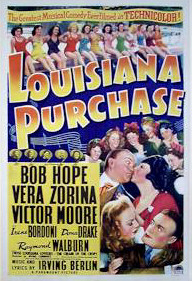
A U.S. senator (Bob Hope) discovers that he was used by a corporation that misused federal funds and they intend to make him the fall guy when hearings are conducted on their corruption by the Senate. Based on the Broadway musical and directed by Irving Cummings (DOWN ARGENTINE WAY). The musical had songs composed by Irving Berlin but over half of the show's songs are ditched in this film version. It's not a musical now but just a comedy with songs. Never having seen the original stage version in any form, I don't know how good a musical it was. But the movie seems compromised, neither a full blown musical nor a good example of a Bob Hope comedy. The stage version was a political satire while the movie makes Republican jokes that don't hold up today. I only laughed once and that was a sight gag when Hope squeezed a lemon. It's chief asset is the vivid Technicolor and Raoul Pene Du Bois' production and costume design. Victor Moore, Vera Zorina and Irene Bordoni recreate their stage roles. With Frank Albertson, Dona Drake, Maxie Rosenbloom and Raymond Walburn.
A struggling actor (Craig Wasson) is house sitting an ultra modern secluded home in the Hollywood Hills. Looking through a telescope, he becomes obsessed with a woman (Deborah Shelton) across the way and when he suspects she may be in danger, he begins to follow her. Directed by Brian De Palma, this is yet another stylish Hitchcock homage. Stylish being the operative word because the film is all style and very little else. Fortunately, the style is so rich that it sustains the film through some very rocky territory. The cuckoo plot depends too much on coincidence and everything falls into place too neatly. You either swallow De Palma's loopy narrative or you don't. If you don't, the film won't work for you on any level. With his ace cinematographer Stephen H. Burum (THE UNTOUCHABLES) and his composer Pino Donaggio (CARRIE) as co-conspirators, he gets the job done. Where he fails big time (with one marvelous exception) is with his actors. De Palma has drawn performances from Sissy Spacek, John Travolta, Angie Dickinson to name just three that rank with their best work. The male leads here (Wasson, Gregg Henry) are just awful and Shelton is used merely for her looks (even her voice is dubbed by another actress). The exception is Melanie Griffith as a porn actress who walks off with the picture and won the supporting actress award from the National Society of Film Critics. With Guy Boyd, Dennis Franz and Barbara Crampton.
In order to save the life of the woman (Leonora Ruffo) he loves, Hercules (Reg Park) must descend into the underworld of Hades and retrieve a stone with magical powers. Photographed and directed by Mario Bava (LISA AND THE DEVIL), this slice of peplum wasn't released in the U.S. until 1964. The storyline is a typical sword and sandal narrative. What distinguishes it from most of the Italian Hercules/Samson/Goliath movies is its visual look and style. Bava disguises the usual cheesy look of the genre with vivid colors and filters, shadows and fog. This gives the film a magical aura (or mythological if you prefer) and atmosphere to the movie to make it (seem) out of the ordinary. I watched an Italian language transfer of the film (with subtitles). I imagine watching an English dub would be quite a different experience. With Christopher Lee as the blood drinking villain, George Ardisson, Marisa Belli, Ida Galli and Franco Giacobini, who provides some ill conceived comic relief.
On the run from the police, three con men (Dick Haymes, Roland Young, Lionel Stander) pose as ministers to elude the cops. But they find that their new identities bring unforeseen consequences. Directed by cult director Edgar G. Ulmer ((DETOUR), this tepid comedy takes a premise that might have been silly fun and flattens all attempts at humor. Young and Stander have comedic credentials so they do what they can with the material at hand but the callow Dick Haymes and Nina Foch as his romantic interest lack the chops to overcome the inferior material. Mercifully short at an hour and 21 minutes, the movie still drags. It was interesting to see former child star Freddie Bartholomew (in his last movie role) as a nerdy minister. You'd never have recognized him if you hadn't seen his name in the credits. The bouncy score by Robert W. Stringer isn't half bad. With Dick Gordon, Jean Casto and John Lupton.

A mother and homemaker (Kathleen Turner) appears to be the epitome of the typical suburban housewife with the perfect family consisting of a dentist husband (Sam Waterston), a daughter (Ricki Lake) attending college and son (Matthew Lillard) who manages a video store. She's also a psychopathic serial killer. Written and directed by John Waters (PINK FLAMINGOS), the film is borderline offensive and frequently gross. But it's also a very funny satire and you know going in that it's John Waters so you're forewarned. It's essentially a one joke premise but Waters is smart enough to move it along quickly and wrap it up in 90 minutes so it doesn't wear out its welcome. Turner wisely plays her performance seriously rather than for laughs which makes it all the more amusing (and frightening). Basil Poledouris's pastiche score is often witty with strains of Bernard Herrmann, Jerry Goldsmith and Howard Shore (his Cronenberg scores). With Suzanne Somers, Mink Stole, Bess Armstrong, Patricia Hearst, Mary Jo Catlett, Traci Lords and Joan Rivers.


